
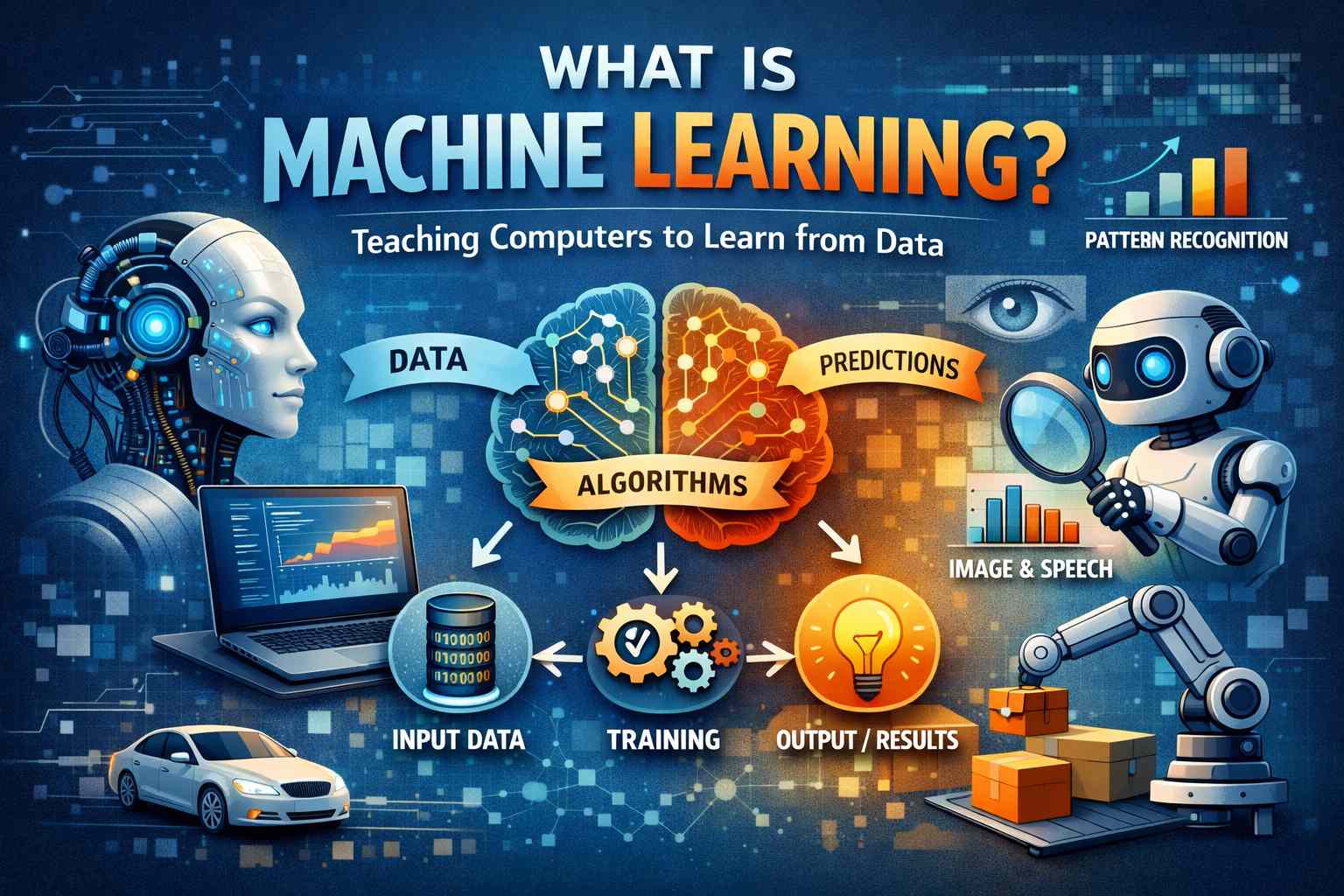
What is Machine Learning? Machine Learning is one of the most exciting parts of modern technology. It is a branch of Artificial Intelligence (AI) that allows computers to learn from data and make decisions without being explicitly programmed.
In simple words, machine learning teaches computers to learn from experience—just like humans do.
What is Machine Learning?Real-Life Examples of Machine Learning
Machine learning is already part of your daily life, even if you don’t notice it:
- YouTube & Netflix – Recommend videos and shows
- Google Maps – Predicts traffic and best routes
- Email – Filters spam messages
- Online Shopping – Suggests products you may like
- Voice Assistants – Understand your voice commands
2. How Machine Learning Works
- Data → Training → Model → Prediction
- Role of algorithms
- Importance of data quality
Data-Driven Insights: are meaningful conclusions or understandings gained by analyzing data, which help in making informed decisions instead of relying on guesswork or intuition.
Role of Algorithms: Algorithms are the core of machine learning; they process data, learn patterns, and build models that enable computers to make decisions or predictions automatically.
Importance of Data Quality: High-quality data ensures accurate, reliable, and meaningful results in machine learning, while poor-quality data can lead to incorrect predictions and weak model performance.
3. Types of Machine Learning
Machine learning is mainly divided into three types:
a) Supervised Learning
Supervised Learning is a type of machine learning where the model is trained using labeled data, meaning each input comes with the correct output. The system learns the relationship between input and output so it can make accurate predictions on new data.
Example: Predicting house prices based on past data or identifying emails as spam or not spam.
b) Unsupervised Learning
Unsupervised Learning is a type of machine learning where the model works with unlabeled data and tries to find hidden patterns or structures on its own. It does not know the correct answers beforehand.
Example: Grouping customers into segments based on buying behavior or detecting unusual patterns in transactions (fraud detection).
c) Reinforcement Learning
Reinforcement Learning is a type of machine learning where a system learns by trial and error. It takes actions in an environment and receives rewards or penalties based on the outcomes, gradually improving its strategy over time.
Example: Self-driving cars learning to navigate traffic safely or a game AI improving its moves to win.
4. Key Concepts You Should Know
Dataset (Training & Testing Data)
A dataset is a collection of data used to train and evaluate a machine learning model. It is usually divided into two parts:
- Training Data – This is the data used to teach the model. The system learns patterns, relationships, and rules from this data.
- Testing Data – This data is kept separate and is used to evaluate the model’s performance. It checks how well the model makes predictions on new, unseen data.
Example: If you’re building a model to predict house prices, the training data would include past house sales, and the testing data would check if the model can accurately predict prices for houses it hasn’t seen before.
Features and Labels
In machine learning, features and labels are the key parts of a dataset:
-
Features – These are the input variables that the model uses to make predictions. They describe the characteristics of the data.
Example: In predicting house prices, features could be the size of the house, number of bedrooms, or location. -
Labels – These are the output or target values that the model is trying to predict.
Example: In the same house price prediction, the label would be the actual price of the house.
Together, features and labels allow the model to learn patterns and make accurate predictions.
Model & Algorithm
In machine learning, models and algorithms are closely related but different:
-
Algorithm – An algorithm is a set of rules or instructions that tells the computer how to learn from data. It defines the learning process.
Example: Linear Regression, Decision Trees, or Neural Networks are types of algorithms. -
Model – A model is the result of training an algorithm on data. It represents the patterns the system has learned and can be used to make predictions on new data.
Example: A trained house price prediction model built using a linear regression algorithm.
In short, the algorithm is the recipe, and the model is the cake you get after training.
Overfitting vs Underfitting
In machine learning, overfitting and underfitting describe how well a model learns from data:
-
Overfitting – The model learns the training data too well, including the noise and small details. It performs great on training data but poorly on new, unseen data.
Example: Memorizing answers instead of understanding the concept. -
Underfitting – The model fails to learn patterns from the training data. It performs poorly on both training and new data.
Example: Giving very general answers that miss important details.
Goal: Build a model that balances learning—good enough to capture patterns but not so much that it memorizes everything.
5. Real-Life Applications of Machine Learning
Machine learning is all around us, making our lives easier, smarter, and more efficient. Here are some real-life examples:
1. Recommendation Systems
Platforms like Netflix, YouTube, and Amazon use machine learning to suggest movies, videos, and products based on your past behavior and preferences.
2. Healthcare
Machine learning helps doctors detect diseases, analyze medical images, and predict patient outcomes more accurately.
3. Finance
Banks and financial institutions use it for fraud detection, credit scoring, and predicting market trends.
4. Autonomous Vehicles
Self-driving cars use machine learning to recognize objects, navigate roads, and make real-time decisions.
5. Virtual Assistants
Voice assistants like Siri, Alexa, and Google Assistant rely on machine learning to understand and respond to user commands.
Machine learning is no longer just a tech buzzword—it’s transforming industries and everyday life.
6. Benefits of Machine Learning
Machine learning offers many advantages, making it a key technology in today’s world:
1. Automation of Tasks
It can automate repetitive tasks, saving time and reducing human effort.
2. Better Decision Making
Machine learning analyzes large amounts of data to provide insights and predictions, helping make smarter decisions.
3. Personalization
It enables personalized experiences for users, like recommendations on streaming platforms or online shopping.
4. Improved Accuracy
Models improve over time and provide highly accurate predictions when trained with good data.
5. Efficiency and Productivity
Machine learning helps businesses streamline operations and optimize resources.
6. Adaptability
Models can adapt to new data and changing environments, making systems flexible and dynamic.
7. Detecting Patterns
It can uncover hidden patterns and trends in data that humans might miss.
7. Challenges in Machine Learning
Machine learning is powerful, but it comes with some key challenges:
- Requires Large Data – Machine learning models need huge amounts of data to learn patterns accurately. Without enough data, predictions may be unreliable.
- Bias and Fairness Issues – If the training data is biased, the model can make unfair or discriminatory decisions, affecting results and trustworthiness.
- High Computational Cost – Training complex models, especially deep learning models, requires powerful hardware and a lot of processing time, which can be expensive.
8. Tools and Languages Used
- Python (most popular)
- Libraries: TensorFlow, Scikit-learn, Pandas
- Basic mention of data science tools
a )Python – The Most Popular Language for Machine Learning
Python is the most widely used programming language for machine learning due to its simplicity, readability, and strong library support. It allows developers to build powerful machine learning models quickly and efficiently.
b)Libraries: TensorFlow, Scikit-learn, Pandas
Python offers several powerful libraries that make machine learning easier and more efficient. TensorFlow is widely used for building deep learning and neural network models, while Scikit-learn provides a variety of classical machine learning algorithms for tasks like classification, regression, and clustering. Pandas is essential for data manipulation and analysis, helping to clean and prepare datasets before training models. Together, these libraries form a robust toolkit for developing and deploying machine learning solutions.
c)Basic mention of data science tools
Data science relies on a variety of tools to collect, analyze, and visualize data efficiently. Some of the most commonly used tools include Python and R for programming, Jupyter Notebook for interactive coding, Excel for basic data handling, Tableau and Power BI for data visualization, and SQL for managing and querying databases. These tools help data scientists transform raw data into meaningful insights that drive better decisions.
9. Future of Machine Learning
The future of machine learning is incredibly promising, as it continues to transform industries and everyday life. We can expect more advanced AI systems capable of learning with less data, making real-time predictions, and automating complex tasks. Machine learning will play a bigger role in healthcare, finance, education, transportation, and even creative fields like art and music. With ongoing research in explainable AI, ethical AI, and reinforcement learning, the technology is set to become smarter, fairer, and more integrated into our daily lives.
Conclusion
Machine learning is transforming the way we live and work, making computers smarter, faster, and more capable of solving complex problems. From understanding data and building models to making predictions and powering real-life applications, the basics of machine learning lay the foundation for endless possibilities. By learning about datasets, algorithms, models, and tools like Python and TensorFlow, anyone can start exploring this exciting field. As technology evolves, machine learning will continue to shape our future, offering smarter solutions and opening doors to innovation across every industry.
Blog
This section provides an overview of the blog, showcasing a variety of articles, insights, and resources to inform and inspire readers.
-
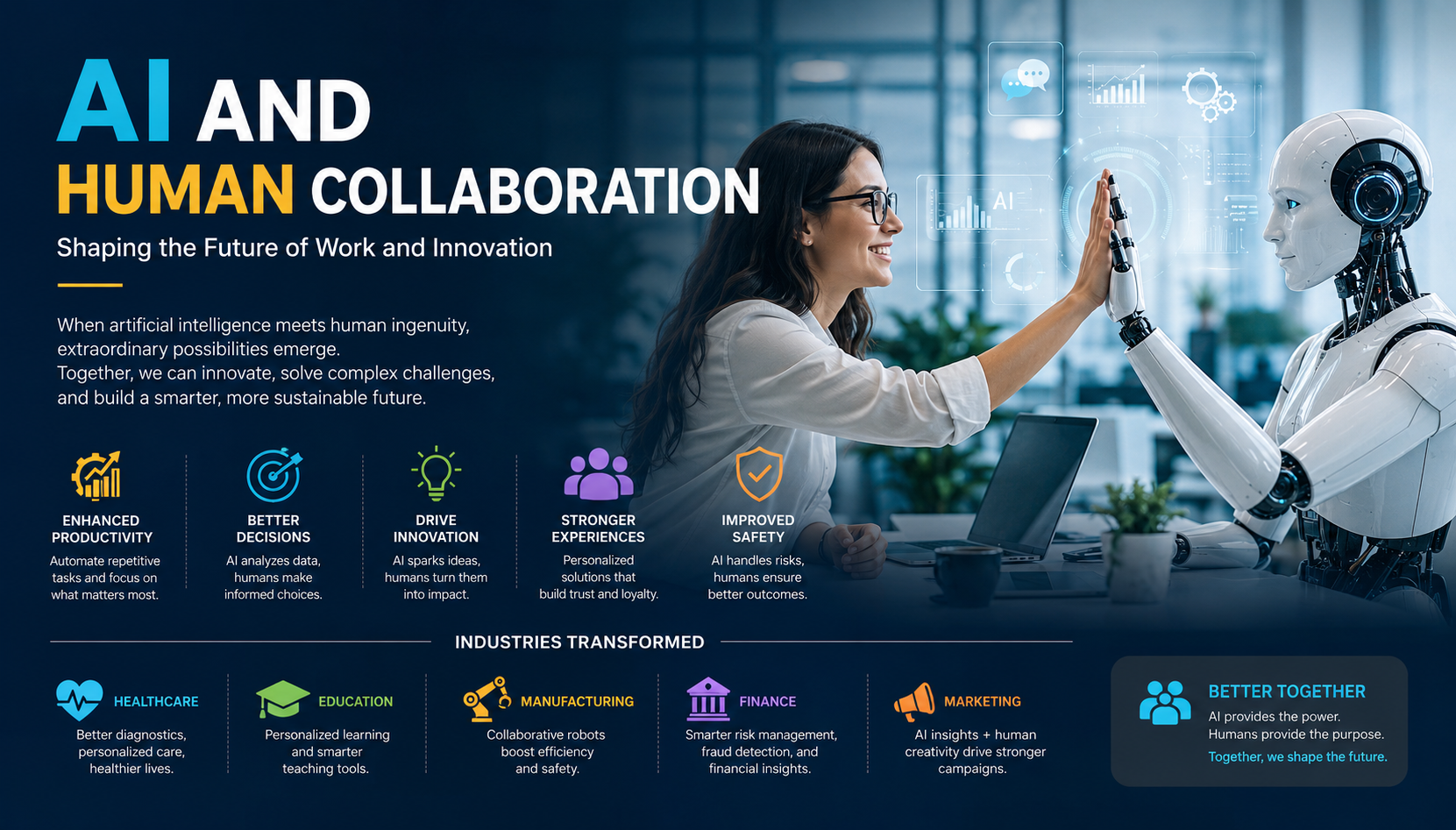
AI and Human Collaboration: Shaping the Future of Work and Innovation
AI and Human Collaboration: Artificial Intelligence (AI) is no longer a futuristic concept limited to science fiction movies. Today, AI has become a powerful force transforming industries, businesses, and daily life. From…
-
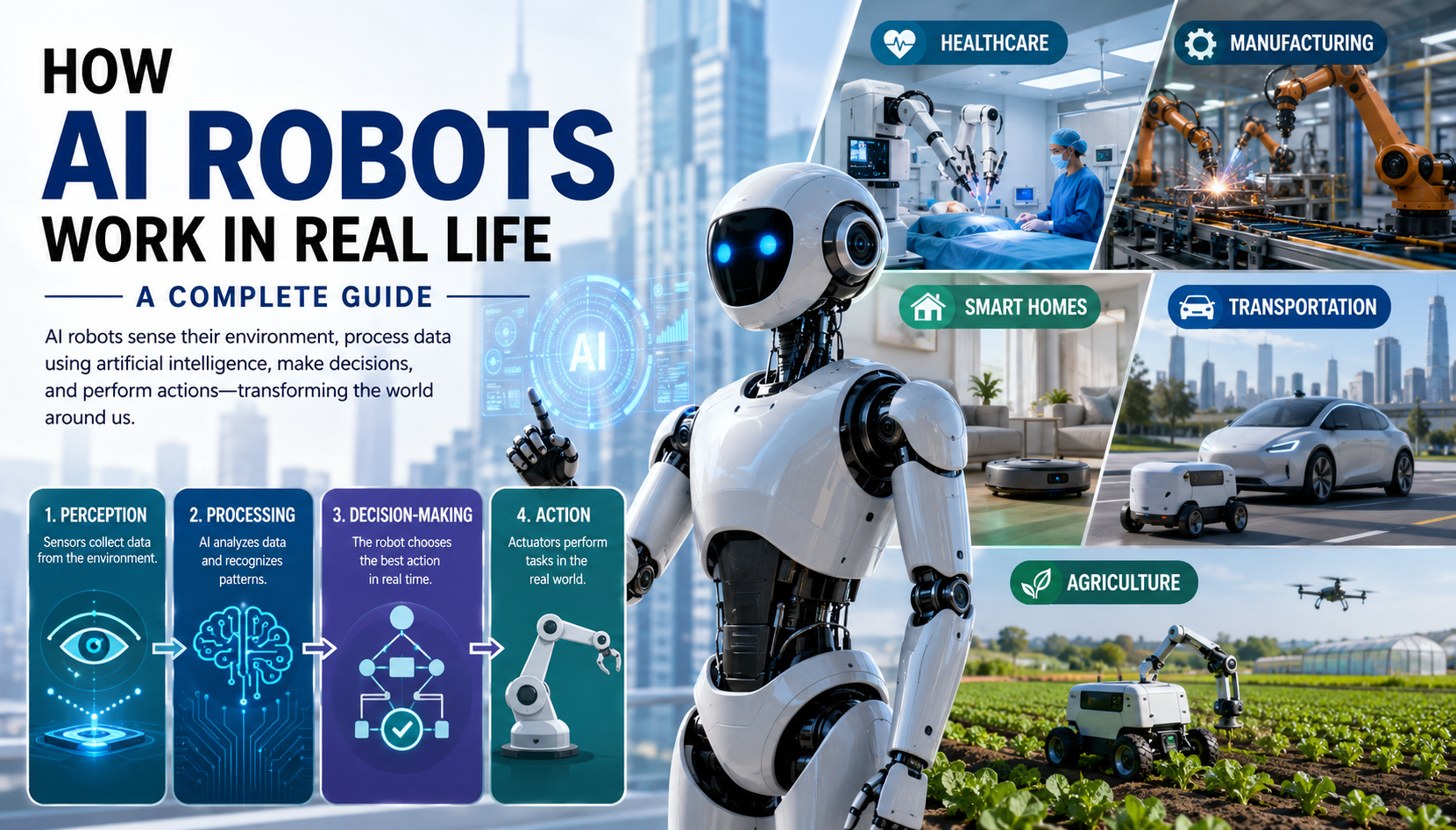
How AI Robots Work in Real Life: A Complete Guide
The idea of robots powered by artificial intelligence once belonged only to science fiction. Today, however, AI robots work in real life across industries, quietly transforming how we live, work, and interact…
-

The Power of AI in Cybersecurity: Smarter Defense, Key Benefits & What’s Next
AI in Cybersecurity has become one of the most critical concerns for organizations in the digital age. As cyber threats grow more sophisticated, traditional security approaches often struggle to keep up. Artificial…

Leave a Reply