
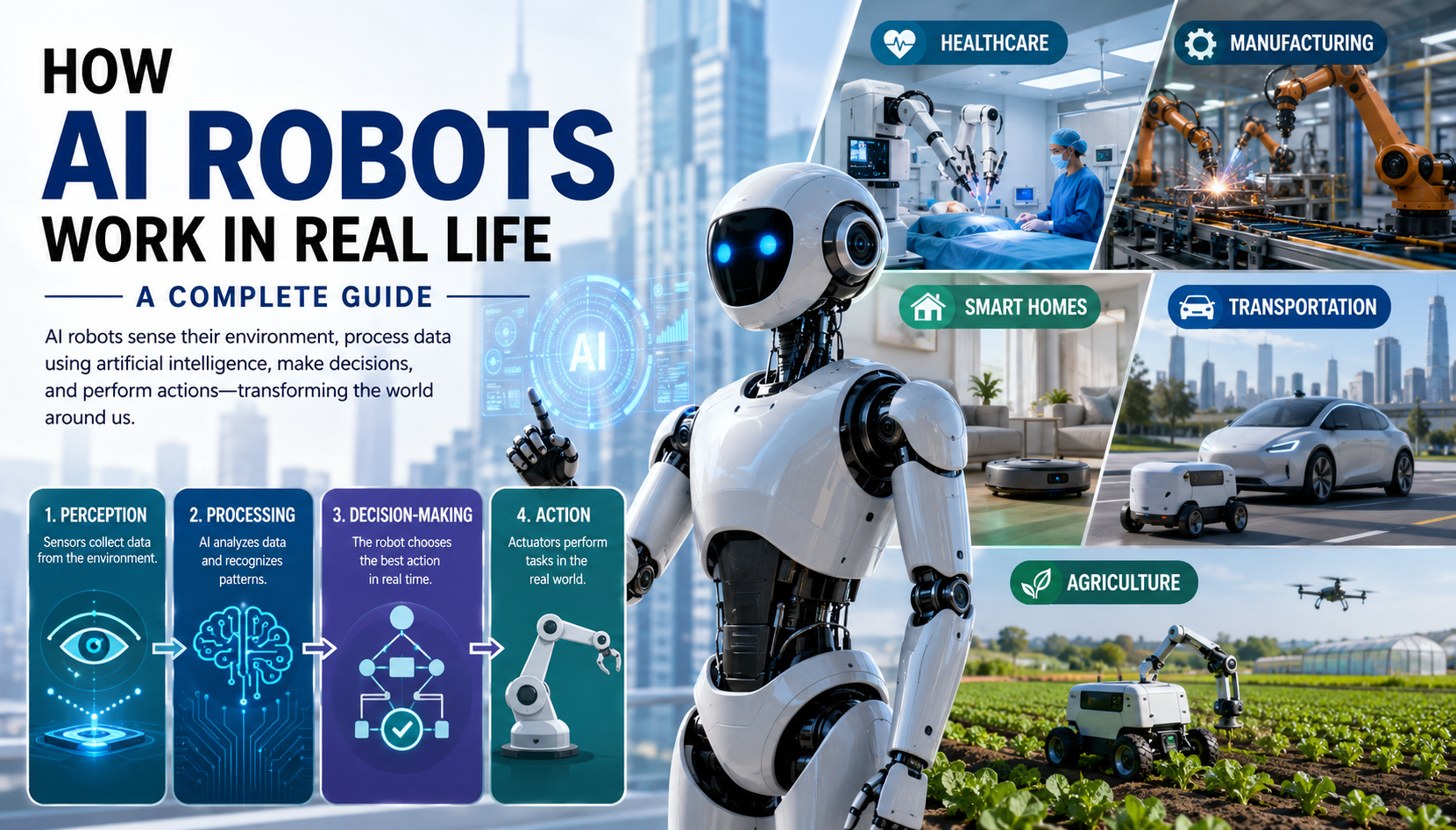
The idea of robots powered by artificial intelligence once belonged only to science fiction. Today, however, AI robots work in real life across industries, quietly transforming how we live, work, and interact with technology. From hospitals and factories to homes and streets, these machines are no longer futuristic concepts—they are practical tools solving real-world problems.
In this article, we’ll explore how AI robots work in real life, breaking down the technology behind them and showing how they are used in everyday situations.
What Are AI Robots?
AI robots are advanced machines that merge physical components with intelligent software, allowing them to operate beyond simple, pre-programmed instructions. Unlike traditional robots that can only perform repetitive tasks in controlled environments, AI robots are designed to learn from experience, adapt to new situations, and make decisions based on real-time data.
At the heart of how AI robots work in real life are three essential components working together seamlessly. Sensors act as the robot’s “eyes and ears,” collecting information from the surrounding environment through cameras, microphones, and other detection systems.
This data is then processed by sophisticated AI algorithms, which analyze patterns, recognize objects, and interpret inputs in a meaningful way—much like the human brain processes sensory information. Finally, actuators enable the robot to take action, whether it’s moving, gripping objects, or communicating with humans.
The integration of these elements allows AI robots to respond intelligently to changing conditions, making them highly useful in dynamic, real-world environments where flexibility and decision-making are crucial.
How AI Robots Work in Real Life
1. Perception: Understanding the Environment
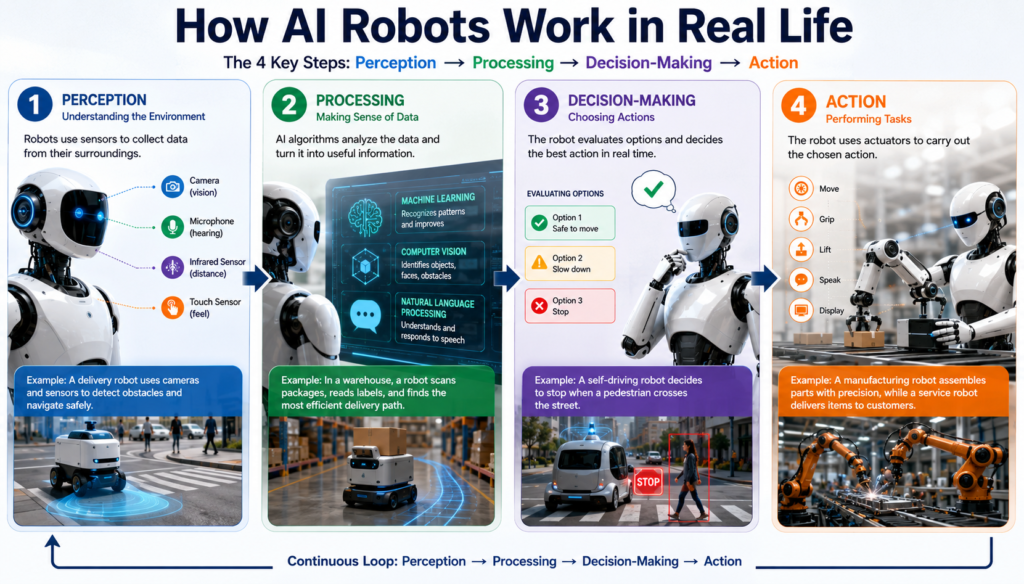
The first and most essential step in how AI robots work in real life is perception, which allows robots to understand and interact with their surroundings. AI robots rely on a wide range of sensors—such as cameras, microphones, infrared sensors, and even touch sensors—to collect data from the environment.
These sensors function similarly to human senses, enabling robots to “see,” “hear,” and “feel” what is happening around them. For example, a delivery robot uses cameras and distance sensors to detect obstacles and navigate safely through streets, while a medical robot continuously monitors patient vitals using specialized sensors.
Similarly, a home assistant robot listens to voice commands and responds accordingly. Without perception, AI robots would have no awareness of their environment, making it impossible for them to operate effectively in real-world situations.
2. Processing: Making Sense of Data
Once data is collected, the next step in how AI robots work in real life is processing, where artificial intelligence comes into play. The robot’s internal system uses advanced AI algorithms to analyze and interpret the incoming data, transforming raw information into meaningful insights.
This involves technologies such as machine learning, which helps the robot recognize patterns and improve over time; computer vision, which enables it to identify objects, faces, or obstacles; and natural language processing, which allows it to understand and respond to human speech.
For instance, in a warehouse setting, an AI robot can scan packages, identify labels, determine their destination, and calculate the most efficient path for delivery. This processing stage is crucial because it bridges the gap between sensing the environment and taking intelligent action.
3. Decision-Making: Choosing Actions
Another key stage in how AI robots work in real life is decision-making, where the robot determines the best course of action based on processed data. Unlike traditional robots that follow fixed instructions, AI robots can evaluate multiple possibilities and choose the most appropriate response in real time.
This ability is what gives them flexibility and adaptability in dynamic environments. For example, a self-driving robot can instantly decide to stop when it detects a pedestrian crossing its path, ensuring safety.
In agriculture, a farming robot may analyze soil and crop conditions to decide which areas need watering or fertilization. Similarly, a customer service robot can select suitable responses based on user queries and context. This intelligent decision-making capability allows AI robots to handle complex tasks and unexpected situations more effectively.
4. Action: Performing Tasks
The final step in how AI robots work in real life is action, where the robot physically carries out the decisions it has made. This is done through actuators—mechanical components that enable movement and interaction with the physical world.
These actuators allow robots to perform a wide range of tasks, such as moving on wheels or legs, operating robotic arms, picking up and placing objects, or even speaking and displaying information on screens.
For example, a manufacturing robot may assemble parts with precision, while a service robot might deliver items or communicate with users. What makes this process powerful is that it operates in a continuous loop—perception, processing, decision-making, and action—allowing AI robots to adapt instantly to changes in their environment. This ongoing cycle is the foundation of how AI robots function efficiently and intelligently in real-life scenarios.
Real-Life Applications of AI Robots
AI Robots in Healthcare
In hospitals, AI robots assist doctors and nurses by performing precise tasks. They can help in surgeries, deliver medicines, and even monitor patients.
Some robots can:
- Assist in minimally invasive surgeries
- Disinfect hospital rooms
- Provide companionship to patients
This improves both efficiency and patient care.
AI Robots in Manufacturing
Factories are one of the most common places where AI robots work in real life. These robots handle repetitive and dangerous tasks with high accuracy.
They are used for:
- Assembly line production
- Quality inspection
- Packaging and logistics
This reduces human error and increases productivity.
AI Robots in Homes
AI-powered robots are becoming part of everyday household life. From cleaning to security, they make daily tasks easier.
Common examples include:
- Robot vacuum cleaners
- Smart assistants
- Home security robots
These robots learn user preferences over time, making them more useful and personalized.
AI Robots in Transportation
Self-driving vehicles and delivery robots are revolutionizing transportation. These systems rely heavily on AI to navigate safely.
They can:
- Detect traffic signals and obstacles
- Plan optimal routes
- Avoid collisions
This technology aims to make transportation safer and more efficient.
AI Robots in Agriculture
Farmers are increasingly using AI robots to improve crop production. These robots help monitor fields and automate labor-intensive tasks.
They can:
- Plant seeds with precision
- Detect crop diseases
- Harvest produce efficiently
This leads to higher yields and reduced resource usage.
Benefits of AI Robots in Real Life
The rise of AI robots brings several advantages:
- Efficiency: Tasks are completed faster and more accurately
- Safety: Robots handle dangerous jobs
- Cost savings: Reduced need for manual labor
- Consistency: High-quality results every time
These benefits explain why AI robots are rapidly being adopted worldwide.
Challenges and Limitations
Despite their advantages, AI robots also face challenges:
- High development and maintenance costs
- Limited understanding in complex situations
- Ethical concerns about job displacement
- Dependence on data quality
Addressing these issues is essential for the responsible growth of AI technology.
The Future of AI Robots
The future of how AI robots work in real life is shaping up to be both transformative and deeply integrated into everyday human experiences. As advancements in artificial intelligence, robotics, and data processing continue to accelerate, AI robots are expected to become far more intelligent, efficient, and accessible than they are today.
These machines will not only perform tasks but also understand context, learn continuously, and interact with humans in more natural and meaningful ways. Over time, the cost of developing and deploying AI robots is likely to decrease, making them available not just to large industries but also to small businesses and households. This shift will expand their presence across different sectors and communities, fundamentally changing how daily activities are carried out.
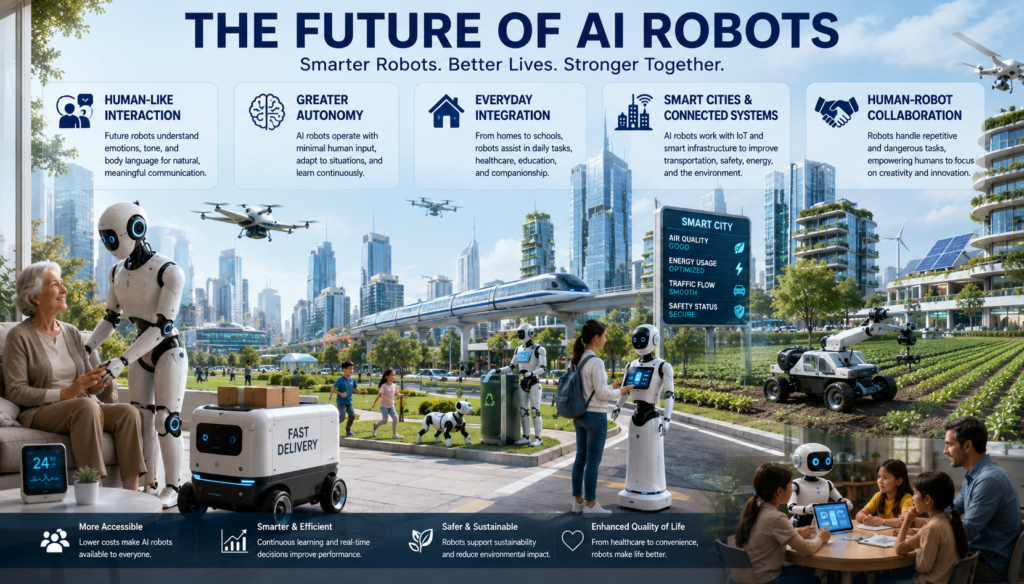
One of the most noticeable developments in how AI robots work in real life will be more human-like interaction. Future robots will be better at understanding emotions, tone of voice, and body language, allowing them to communicate in ways that feel more natural and intuitive. Whether assisting customers, caring for elderly individuals, or supporting education, these robots will create smoother and more personalized interactions. This will help bridge the gap between humans and machines, making technology easier and more comfortable to use.
Another major advancement will be greater autonomy. AI robots will increasingly operate with minimal human intervention, thanks to improvements in machine learning and real-time decision-making. They will be able to handle complex tasks, adapt to unexpected situations, and learn from their experiences without needing constant updates or supervision. For example, autonomous delivery robots, self-operating farming machines, and intelligent industrial systems will become more common, improving efficiency and reducing the need for manual oversight.
In addition, there will be a wider use of AI robots in everyday life. As these technologies become more affordable and user-friendly, they will move beyond specialized industries and into homes, schools, and public spaces. People may rely on AI robots for household chores, personal assistance, healthcare monitoring, and even companionship. This increased accessibility will make AI robots a normal part of daily routines, much like smartphones and the internet today.
The integration of AI robots with smart cities and connected systems will also play a crucial role in the future. AI robots will work alongside technologies such as IoT (Internet of Things), smart infrastructure, and data-driven urban planning to improve transportation, energy management, public safety, and environmental monitoring. For instance, robots could help manage traffic flow, maintain public spaces, or assist in emergency response situations, creating more efficient and sustainable urban environments.
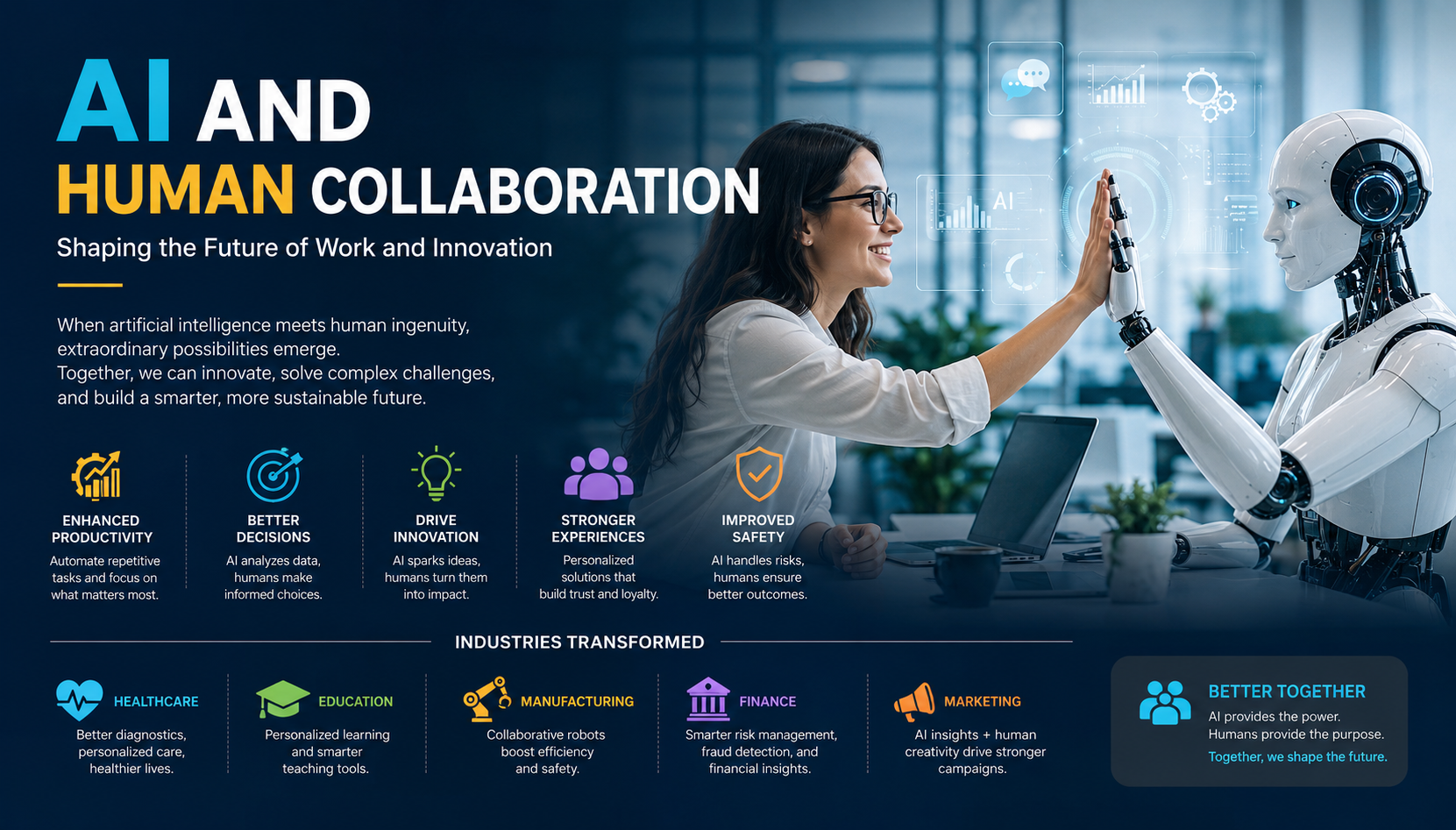
Despite these advancements, it is important to understand that AI robots are not designed to replace humans entirely. Instead, the future of how AI robots work in real life will focus on collaboration between humans and machines. Robots will take over repetitive, dangerous, or time-consuming tasks, allowing humans to focus on creativity, problem-solving, and emotional intelligence. This partnership will enhance productivity and quality of life, rather than diminish the role of human workers.
Conclusion
Understanding how AI robots work in real life helps us see their true value beyond hype. By combining sensors, intelligent processing, and physical actions, these machines can perform complex tasks across many industries.
As AI continues to evolve, robots will play an even bigger role in shaping our future—making life more efficient, safer, and connected.
Focus Keyword Recap: AI robots work in real life by sensing their environment, processing data using artificial intelligence, making decisions, and performing actions—creating powerful systems that are transforming the world around us.

Leave a Reply