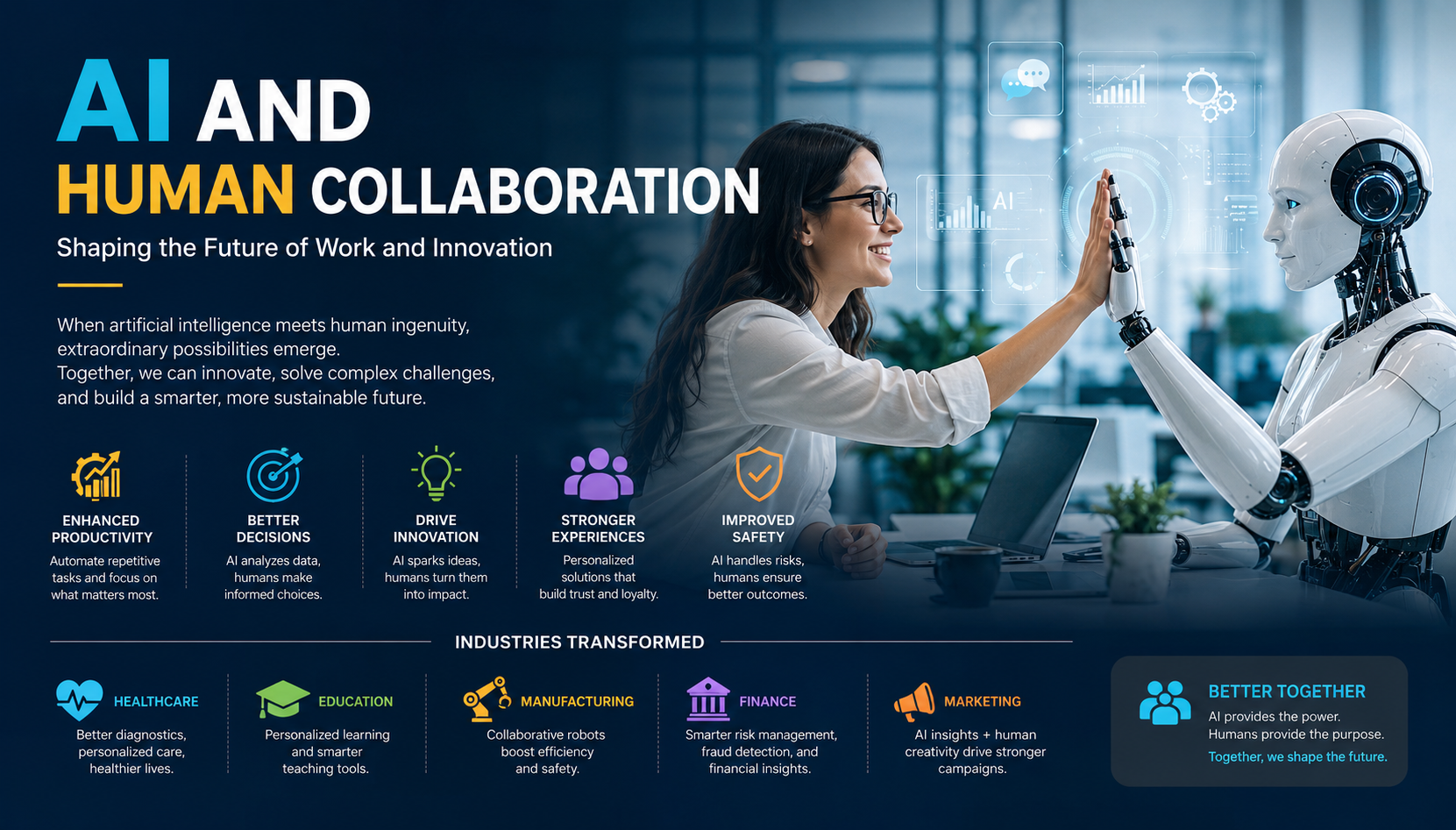
AI and Human Collaboration: Artificial Intelligence (AI) is no longer a futuristic concept limited to science fiction movies. Today, AI has become a powerful force transforming industries, businesses, and daily life. From smart assistants and automated customer support to advanced robotics and predictive analytics, AI is rapidly changing how humans work and interact with technology. However, the true potential of AI lies not in replacing humans, but in creating strong collaboration between humans and intelligent machines.
AI and human collaboration is emerging as one of the most important technological trends of the modern era. By combining human creativity, emotional intelligence, and decision-making skills with AI’s speed, accuracy, and data-processing capabilities, organizations can achieve greater efficiency, innovation, and productivity than ever before.
What Is AI and Human Collaboration?
AI and human collaboration refers to the partnership between people and artificial intelligence systems to complete tasks, solve problems, and improve overall outcomes. Instead of replacing humans, AI works as a supportive technology that enhances human abilities and helps individuals and businesses perform tasks more efficiently. This collaboration combines the unique strengths of humans with the advanced capabilities of AI, creating smarter and more productive working environments across many industries.
Humans bring qualities that machines cannot fully replicate, such as creativity, imagination, emotional understanding, ethical judgment, strategic thinking, leadership, and communication skills. These human abilities are essential for innovation, decision-making, relationship building, and solving complex problems that require empathy and critical thinking. Human intelligence allows organizations to create meaningful strategies and maintain strong personal connections in workplaces and customer interactions.
On the other hand, AI contributes powerful technological capabilities such as data analysis, automation, pattern recognition, fast processing, and predictive insights. AI systems can quickly analyze large amounts of information, identify trends, automate repetitive tasks, and provide accurate recommendations. This helps businesses save time, reduce errors, and improve operational efficiency. By handling routine and data-heavy tasks, AI allows humans to focus on creative, strategic, and high-value activities.
Together, AI and humans create a balanced partnership where technology supports human potential rather than competing with it. This collaboration is transforming industries such as healthcare, education, finance, manufacturing, and customer service by improving productivity, innovation, and decision-making. As AI technology continues to evolve, human-AI collaboration is expected to become even more important in shaping the future of work and digital transformation.
Why AI and Human Collaboration Matters
The rapid growth of digital transformation has increased the need for intelligent systems that can assist humans in complex tasks. AI helps organizations handle massive amounts of data, automate repetitive processes, and improve decision-making. At the same time, humans provide context, empathy, and innovation that machines cannot fully replicate.
This collaboration matters because it:
- Improves productivity
- Reduces operational costs
- Enhances workplace efficiency
- Supports better decision-making
- Increases innovation
- Creates personalized customer experiences
Businesses that successfully combine human intelligence with AI technology are gaining a major competitive advantage in the global market.
How AI Enhances Human Capabilities
1. Automating Repetitive Tasks
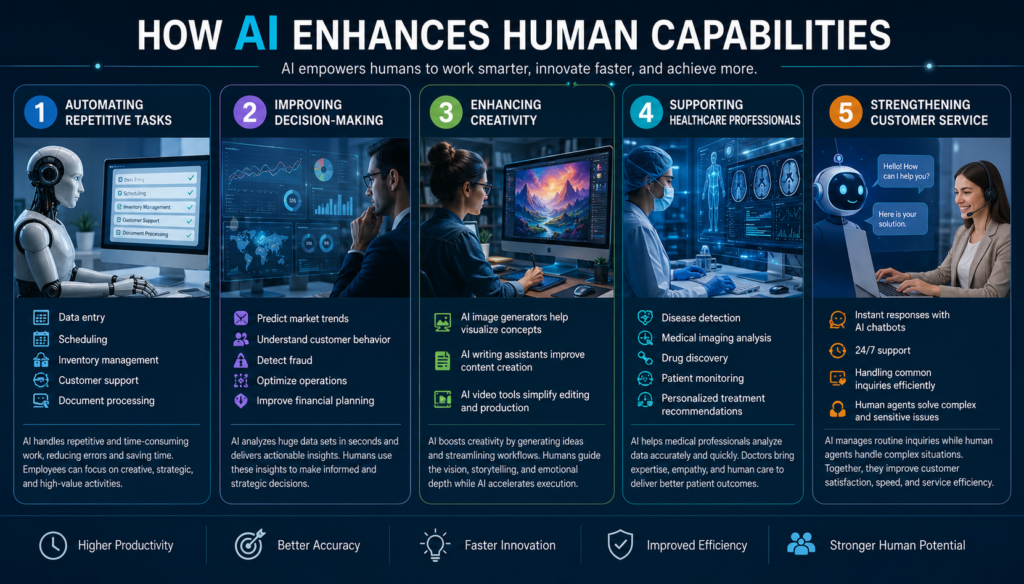
One of the greatest strengths of artificial intelligence is its ability to automate repetitive and time-consuming tasks. AI systems can efficiently manage activities such as data entry, scheduling, inventory management, customer support, and document processing with minimal human involvement. By handling these routine operations, AI helps organizations save time, reduce errors, and improve overall productivity. This automation allows employees to focus on more important responsibilities that require creativity, strategic thinking, and problem-solving skills. As a result, businesses can operate more efficiently while workers can dedicate their energy to high-value and innovative tasks.
2. Improving Decision-Making
AI significantly improves decision-making by analyzing massive amounts of data within seconds and providing valuable insights. Businesses use AI-powered analytics tools to predict market trends, understand customer behavior, detect fraudulent activities, optimize business operations, and improve financial planning. These systems identify patterns and trends that may be difficult for humans to detect manually. Human professionals then use these AI-generated insights to make informed and strategic decisions. By combining human expertise with AI-driven data analysis, organizations can make smarter choices, reduce risks, and achieve better business outcomes.
3. Enhancing Creativity
Contrary to the belief that AI may replace human creativity, AI is actually helping people become more creative and productive. Designers, writers, musicians, marketers, and content creators are increasingly using AI tools to generate ideas, create content, and improve creative workflows. AI image generators help artists visualize concepts more quickly, AI writing assistants support content development, and AI video tools simplify editing and production processes. While AI accelerates execution and provides inspiration, humans remain in control of the creative vision, storytelling, and emotional depth. This partnership between human imagination and AI technology is transforming creative industries and enabling faster innovation.
4. Supporting Healthcare Professionals
AI is revolutionizing the healthcare industry by assisting doctors, nurses, and medical professionals in various critical areas. AI systems help with disease detection, medical imaging analysis, drug discovery, patient monitoring, and personalized treatment recommendations. These technologies can process medical data quickly and accurately, helping healthcare providers diagnose conditions earlier and improve treatment outcomes. However, human doctors still play an essential role by combining AI insights with medical expertise, empathy, and patient communication. This collaboration between AI and healthcare professionals leads to more efficient healthcare services and improved patient care.
5. Strengthening Customer Service
Many businesses are using AI-powered chatbots and virtual assistants to improve customer service experiences. AI systems can instantly respond to simple customer inquiries, provide support 24/7, and handle common requests efficiently. At the same time, human customer service agents focus on solving complex problems and managing emotionally sensitive situations that require empathy and understanding. This balanced collaboration between AI and humans improves customer satisfaction, increases response speed, and enhances overall service efficiency. By combining automation with human interaction, companies can deliver faster, smarter, and more personalized customer support experiences.
Industries Benefiting From AI and Human Collaboration
Healthcare
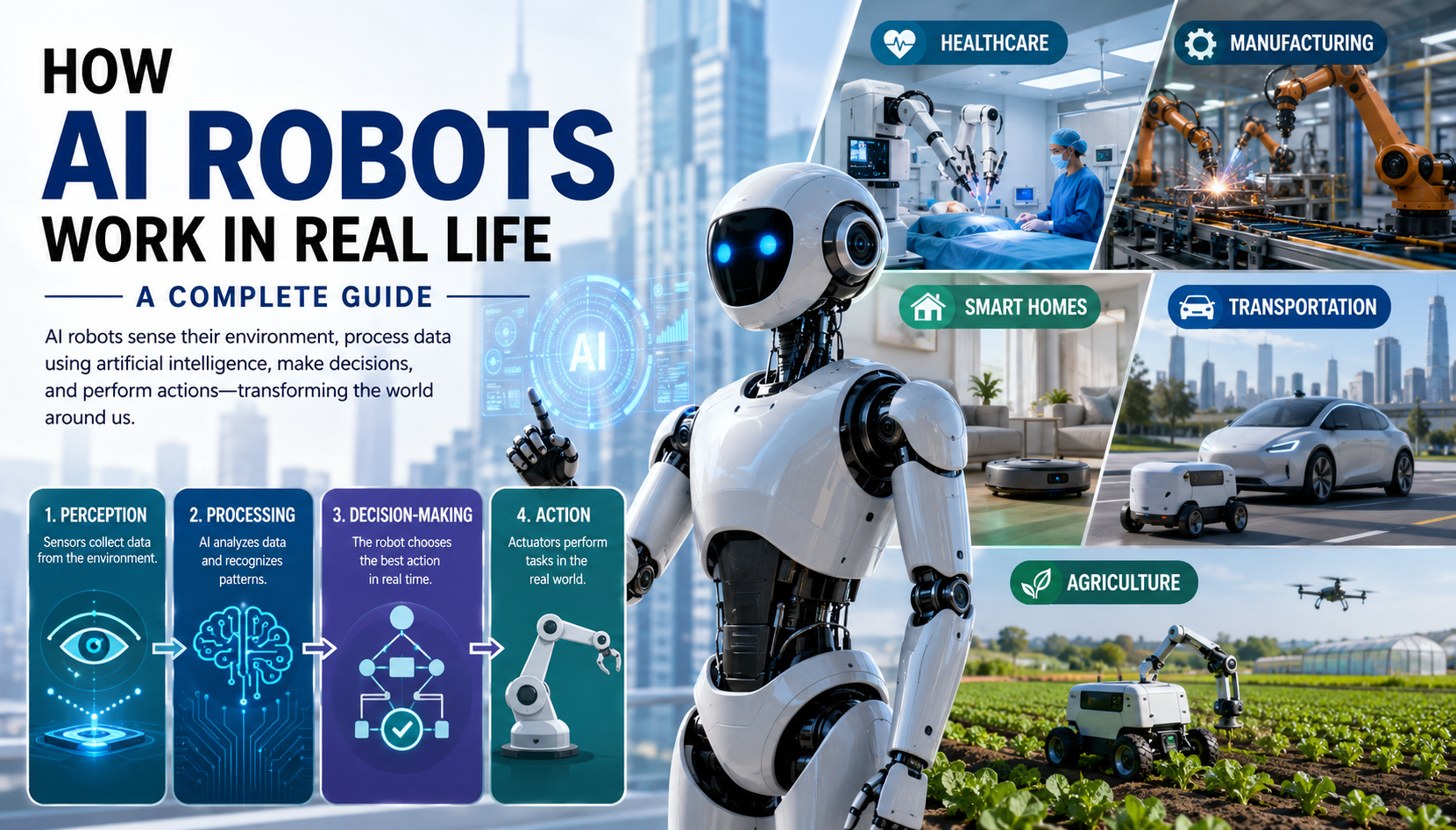
Hospitals and medical institutions use AI for diagnostics, robotic surgery, and predictive healthcare solutions. Human doctors remain essential for patient communication and ethical medical decisions.
Education
AI-powered learning platforms personalize education based on student performance. Teachers use these tools to improve learning experiences while maintaining human interaction and mentorship.
Manufacturing
Factories use collaborative robots, also known as cobots, to work alongside humans. These robots perform physically demanding or repetitive tasks while humans supervise operations and solve complex problems.
Finance
Banks and financial institutions rely on AI for fraud detection, risk assessment, and automated trading. Human analysts interpret results and make strategic financial decisions.
Marketing
AI helps marketers analyze consumer behavior, automate campaigns, and generate insights. Human marketers create branding strategies and emotional storytelling that connect with audiences.
Benefits of AI and Human Collaboration
Increased Productivity
AI speeds up processes and reduces manual effort, allowing teams to accomplish more in less time.
Better Accuracy
AI systems minimize human errors in calculations, data analysis, and repetitive operations.
Faster Innovation
Human creativity combined with AI-powered insights accelerates innovation and product development.
Improved Workplace Safety
In industries such as construction and manufacturing, AI robots can handle dangerous tasks, reducing workplace accidents.
Personalized Experiences
AI enables businesses to deliver highly personalized recommendations and services to customers.
Challenges of AI and Human Collaboration
While AI offers many advantages, there are also challenges that organizations must address.
Job Displacement Concerns
Automation may replace certain routine jobs, creating fears about unemployment. However, AI is also generating new career opportunities in technology, data science, and AI management.
Ethical Issues
AI systems must be designed responsibly to avoid:
- Bias
- Privacy violations
- Discrimination
- Misuse of data
Human oversight remains essential for ethical decision-making.
Dependence on Technology
Overreliance on AI could reduce critical thinking and human problem-solving abilities if not balanced properly.
Skills Gap
Many workers need training to adapt to AI-powered workplaces. Businesses must invest in education and upskilling programs.
The Future of AI and Human Collaboration
The future of AI and human collaboration looks highly promising. Instead of replacing people, AI will increasingly serve as a powerful partner that enhances human potential.
Future trends may include:
- More advanced humanoid robots
- AI-powered virtual workplaces
- Smarter healthcare systems
- Autonomous transportation
- Personalized AI assistants
- Human-AI creative partnerships
As AI technology evolves, collaboration between humans and intelligent systems will become even more integrated into everyday life and business operations.
How Businesses Can Successfully Implement AI Collaboration
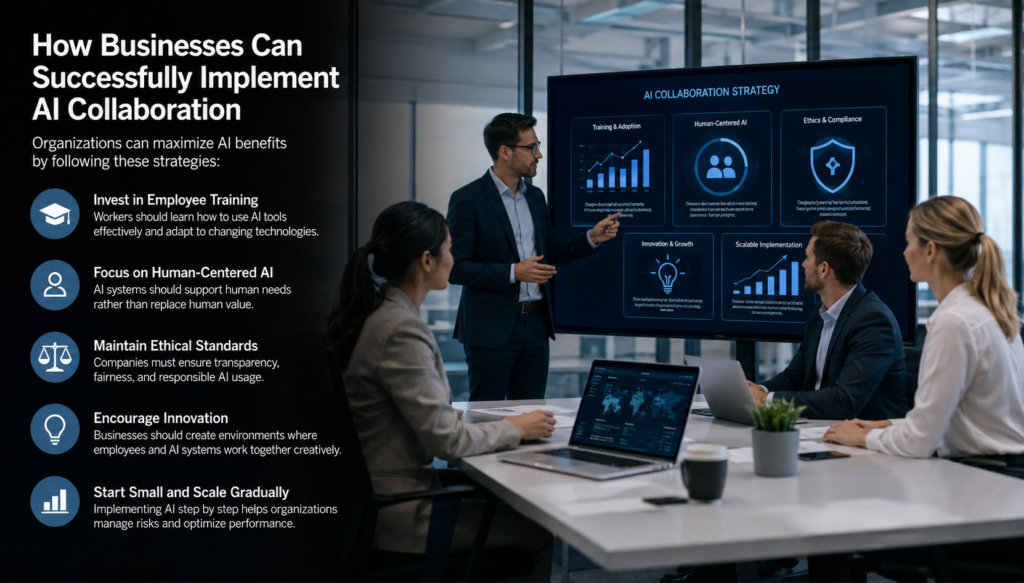
Organizations can maximize AI benefits by following these strategies:
Invest in Employee Training
Workers should learn how to use AI tools effectively and adapt to changing technologies.
Focus on Human-Centered AI
AI systems should support human needs rather than replace human value.
Maintain Ethical Standards
Companies must ensure transparency, fairness, and responsible AI usage.
Encourage Innovation
Businesses should create environments where employees and AI systems work together creatively.
Start Small and Scale Gradually
Implementing AI step by step helps organizations manage risks and optimize performance.
Conclusion
AI and human collaboration is transforming the modern world by combining the strengths of human intelligence with the capabilities of artificial intelligence. Rather than replacing humans, AI is becoming a valuable partner that improves productivity, creativity, efficiency, and innovation across industries.
The future belongs to organizations and individuals who embrace this collaboration responsibly and strategically. By focusing on ethical AI development, workforce training, and human-centered innovation, society can unlock the full potential of AI while preserving the unique qualities that make humans indispensable.
As technology continues to evolve, the partnership between humans and AI will play a crucial role in shaping the future of work, business, healthcare, education, and everyday life.

Leave a Reply