
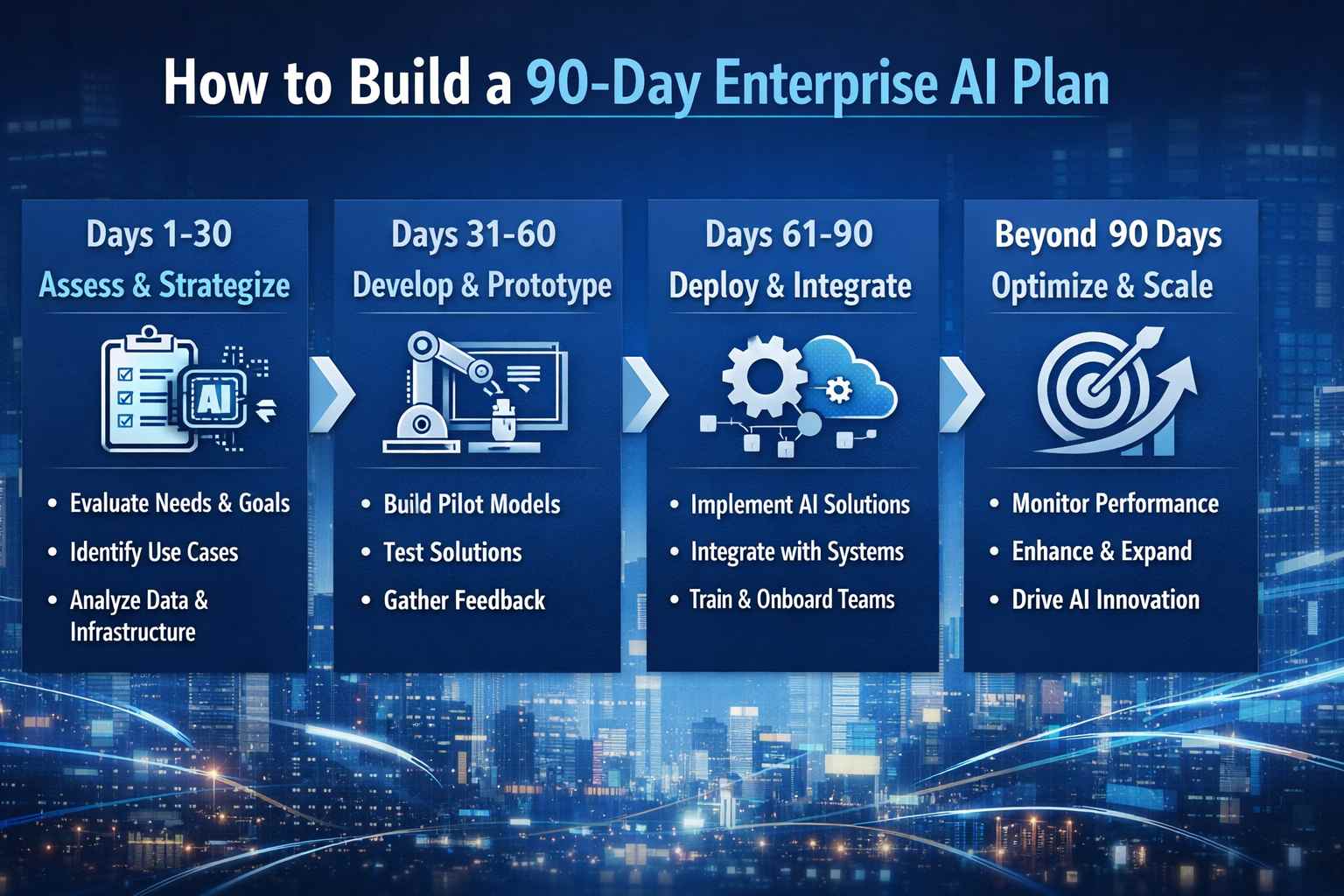
90-day AI plan: Artificial Intelligence (AI) is no longer a futuristic concept—it’s a business necessity. Enterprises across industries are adopting AI to automate operations, improve decision-making, and gain a competitive edge. However, many organizations struggle with where to start. That’s where a structured 90-day AI plan becomes essential.
In this guide, you’ll learn how to build a practical, results-driven enterprise AI strategy in just 90 days. This roadmap is designed to help businesses move from planning to execution efficiently while minimizing risk and maximizing ROI.
Why a 90-Day AI Plan Matters
A 90-day AI plan provides a focused and time-bound framework that prevents analysis paralysis. Instead of spending months in endless discussions, organizations can take action, test ideas, and see measurable results quickly.
This approach also helps align stakeholders, define clear objectives, and ensure that AI initiatives are tied directly to business outcomes such as revenue growth, cost reduction, and customer experience improvement.
Phase 1 (Days 1–30): Strategy, Assessment, and Goal Setting
The first 30 days are all about laying a strong foundation. Without proper planning, even the most advanced AI tools can fail to deliver value.
Start by identifying your business objectives. Ask critical questions such as: What problems are we trying to solve? Where are the inefficiencies? Which processes can benefit from automation? Common use cases include customer support automation, predictive analytics, fraud detection, and personalized marketing.
Next, conduct a data assessment. AI thrives on data, so you need to evaluate the quality, availability, and accessibility of your data. Identify gaps, inconsistencies, and compliance issues. Clean, structured, and relevant data is key to successful AI implementation.
It’s also important to assess your current technology infrastructure. Determine whether your existing systems can support AI tools or if you need cloud-based solutions. Many enterprises choose scalable platforms to avoid heavy upfront investments.
Finally, build your AI team. This doesn’t necessarily mean hiring a large group of experts. Instead, create a cross-functional team that includes IT professionals, data analysts, business leaders, and decision-makers. Collaboration is essential for aligning AI initiatives with business goals.
Phase 2 (Days 31–60): Pilot Projects and AI Model Development
Once your strategy is in place, the next 30 days focus on execution through pilot projects. Instead of trying to implement AI across the entire organization, start small with one or two high-impact use cases.
Choose projects that are achievable, measurable, and aligned with business priorities. For example, implementing a chatbot for customer service or using AI for sales forecasting can deliver quick wins.
During this phase, begin developing and training AI models. Use historical data to train algorithms and test their accuracy. It’s important to iterate continuously—AI models improve over time with more data and refinement.
Integration is another key step. Ensure that your AI solution works seamlessly with existing systems such as CRM, ERP, or marketing platforms. Smooth integration reduces friction and increases adoption across teams.
Additionally, establish key performance indicators (KPIs) to measure success. Metrics such as efficiency improvement, cost savings, customer satisfaction, and revenue growth will help you evaluate the impact of your AI initiatives.
Phase 3 (Days 61–90): Deployment, Scaling, and Optimization
The final phase focuses on deploying AI solutions and scaling them across the organization. By this stage, you should have validated your pilot projects and identified what works.
Begin by rolling out successful AI models to a larger audience or across multiple departments. Ensure that employees are properly trained to use AI tools effectively. Change management plays a crucial role here—people need to understand how AI will support their work, not replace it.
Monitoring and optimization are continuous processes. Track performance metrics and gather feedback from users. Identify areas for improvement and refine your models accordingly. AI is not a one-time implementation—it requires ongoing updates and maintenance.
Security and compliance should also be prioritized. Ensure that your AI systems follow data protection regulations and ethical guidelines. This builds trust and reduces potential risks.
Key Benefits of a 90-Day Enterprise AI Plan
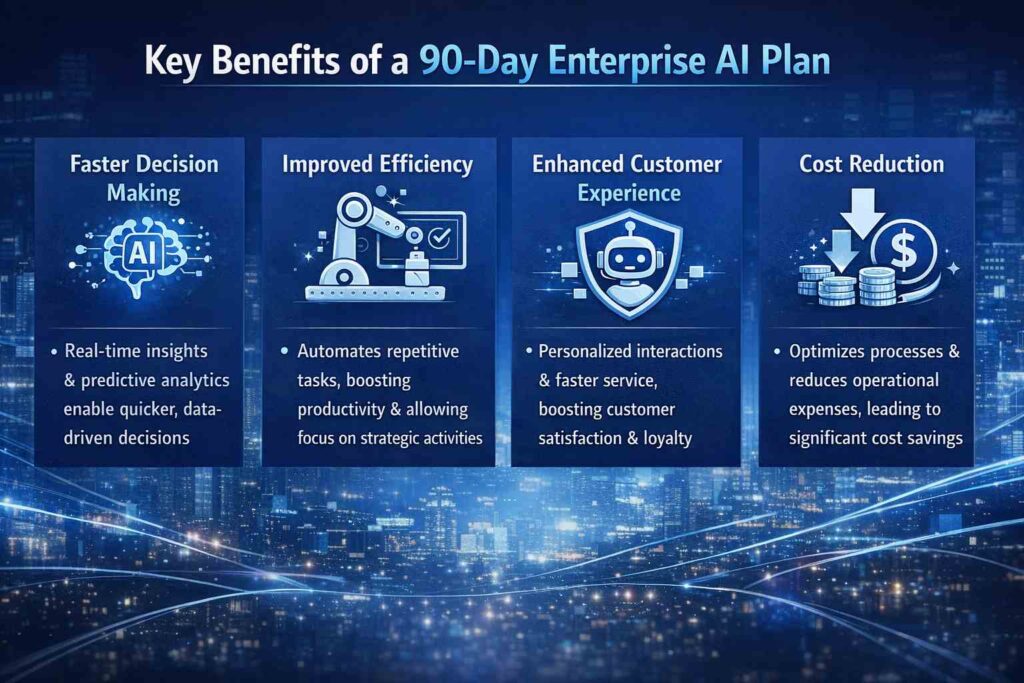
A well-executed AI plan delivers several advantages. It accelerates decision-making by providing real-time insights and predictive analytics. It also improves operational efficiency by automating repetitive tasks, allowing employees to focus on strategic activities.
Another major benefit is enhanced customer experience. AI enables personalized interactions, faster response times, and better service quality. Over time, this leads to increased customer loyalty and retention.
Cost reduction is another critical outcome. By optimizing processes and reducing manual effort, businesses can significantly lower operational expenses.
Common Challenges and How to Overcome Them
Despite its benefits, implementing AI comes with challenges. One of the biggest hurdles is poor data quality. Without accurate data, AI models cannot deliver reliable results. Investing in data management and governance is essential.
Another challenge is resistance to change. Employees may feel threatened by AI technologies. To overcome this, organizations should focus on education, training, and clear communication about the benefits of AI.
Budget constraints can also limit AI adoption. Starting with small pilot projects helps demonstrate value and justify further investment.
Lastly, a lack of expertise can slow down progress. Partnering with AI consultants or using AI-as-a-service platforms can help bridge the skill gap.
Best Practices for Success
To ensure the success of your 90-day AI plan, focus on clear objectives and measurable outcomes. Avoid overcomplicating your strategy—start simple and scale gradually.
Maintain strong collaboration between technical and business teams. AI should not operate in isolation; it must align with overall business strategy.
Invest in continuous learning and improvement. The AI landscape evolves rapidly, so staying updated with the latest trends and technologies is crucial.
Conclusion
Building a 90-day enterprise AI plan is one of the most effective ways to kickstart your organization’s AI journey. By following a structured approach—focusing on strategy, pilot projects, and scaling—you can achieve tangible results in a short period.
AI is not just about technology; it’s about transformation. Organizations that adopt a clear, actionable roadmap will be better positioned to innovate, compete, and grow in today’s digital economy.


Leave a Reply