

Decision Intelligence In 2026, businesses are operating in a faster, more competitive, and data-driven environment than ever before. Organizations no longer rely only on traditional reporting systems to make strategic choices. They now need intelligent platforms that can analyze data, predict outcomes, and recommend the best actions in real time. This is where Decision Intelligence is reshaping the future of Enterprise Resource Planning (ERP). By combining artificial intelligence, machine learning, predictive analytics, and automation, Decision Intelligence helps businesses make smarter, faster, and more accurate decisions across every department.
What is Decision Intelligence in ERP?
Decision Intelligence is the next evolution of business technology that merges data science, artificial intelligence, and decision-making frameworks into one powerful system. In ERP, it means using intelligent tools inside finance, HR, supply chain, manufacturing, sales, and operations modules to improve decision quality. Instead of simply showing reports or dashboards, ERP systems with Decision Intelligence can interpret patterns, forecast future scenarios, and suggest actions based on business goals.
For example, instead of manually checking stock reports, an ERP system powered by Decision Intelligence can predict inventory shortages before they happen and recommend restocking schedules. This shifts ERP from a passive management tool into an active strategic advisor.
Why Decision Intelligence Matters in 2026
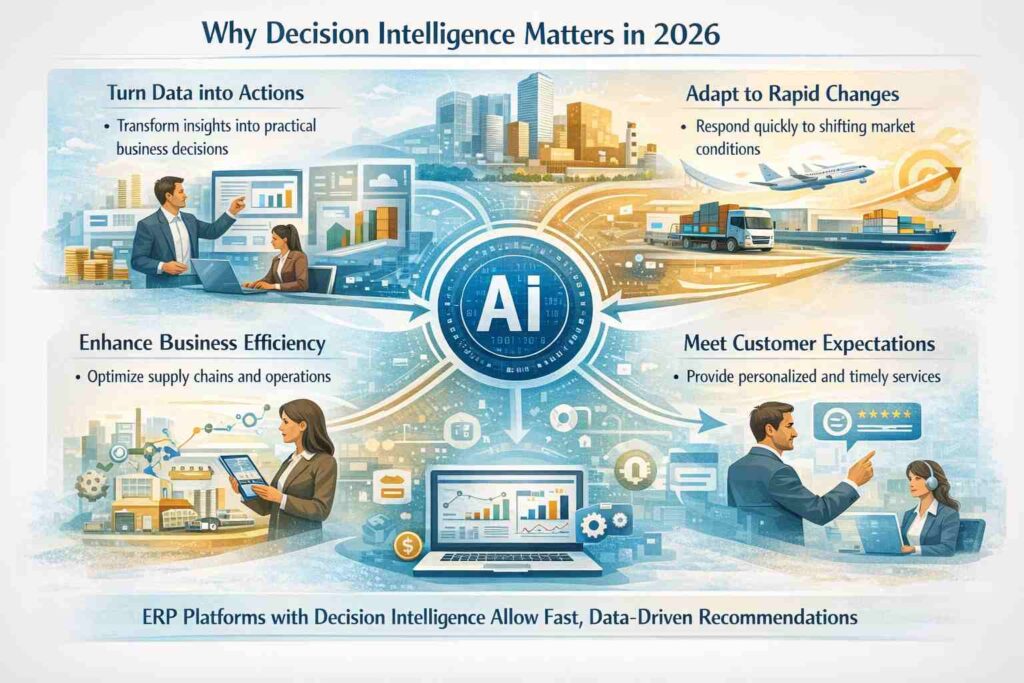
Modern businesses generate massive volumes of data every day. Sales records, supplier performance, employee productivity, customer behavior, logistics updates, and market trends all create valuable insights. However, raw data alone does not create business success. Companies need systems that can convert this information into practical decisions quickly.
In 2026, Decision Intelligence is essential because market conditions change rapidly. Supply chains are more complex, customer expectations are higher, and operational costs are under constant pressure. ERP platforms with Decision Intelligence allow organizations to respond instantly by providing recommendations backed by data rather than assumptions.
Key Features of Decision Intelligence in ERP
One of the strongest features of Decision Intelligence is predictive analytics. ERP systems can study historical and live data to forecast sales demand, cash flow changes, workforce needs, and production capacity. This helps leaders plan ahead rather than reacting after problems occur.
Another major feature is automated recommendations. Decision Intelligence tools can suggest the best vendor based on pricing, delivery history, and quality ratings. They can recommend pricing adjustments based on customer demand or advise on staffing levels during seasonal changes.
Scenario modeling is also highly valuable. Businesses can test “what-if” situations before making costly decisions. For example, a company can evaluate how changing suppliers, increasing prices, or expanding into a new region may affect profits and operations.
Real-time alerts are another critical advantage. Instead of discovering issues in monthly reports, ERP systems notify managers immediately about unusual spending, production delays, or customer churn risks. This enables fast corrective action.
How Decision Intelligence Improves ERP Departments
Finance and Accounting
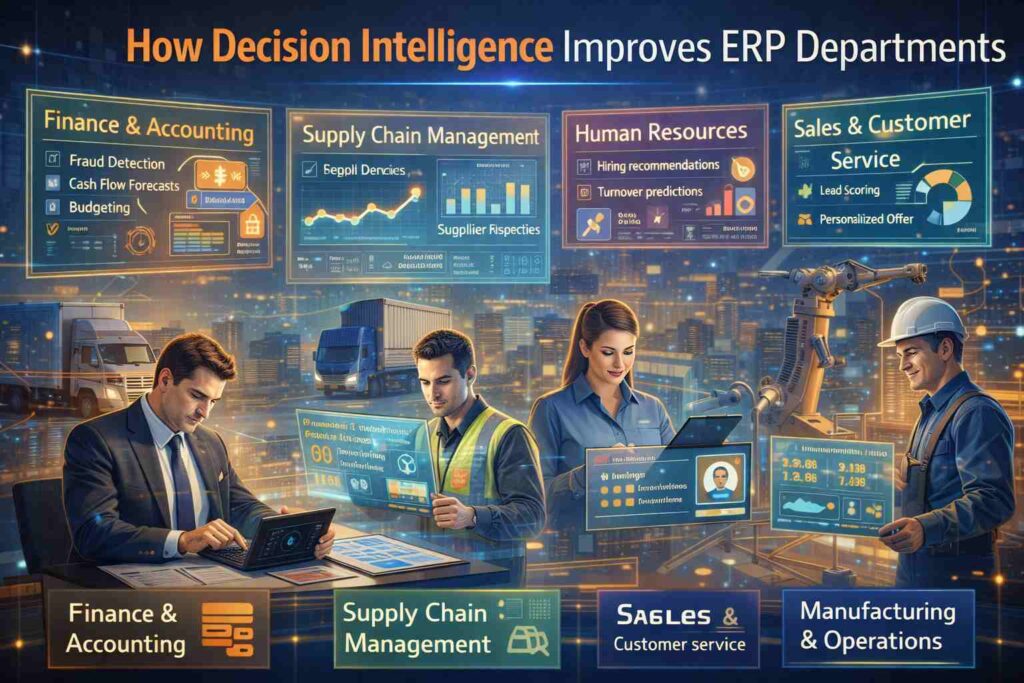
Finance teams use Decision Intelligence to improve budgeting, forecasting, fraud detection, and expense control. ERP systems can identify unusual transactions, predict cash shortages, and recommend ways to optimize working capital. This improves financial stability and strategic planning.
Supply Chain Management
Supply chain disruptions remain a global challenge in 2026. Decision Intelligence helps businesses identify risks, predict delays, optimize routes, and improve supplier selection. ERP systems become smarter at balancing inventory levels while reducing storage costs.
Human Resources
HR departments use Decision Intelligence to predict employee turnover, improve hiring decisions, and optimize workforce scheduling. ERP systems can identify skill gaps and recommend training programs that align with future business needs.
Sales and Customer Service
Sales teams benefit through smarter forecasting, lead scoring, and personalized offers. Customer service departments can predict complaints, monitor satisfaction trends, and resolve issues faster through automated recommendations.
Manufacturing and Operations
Manufacturers use Decision Intelligence for predictive maintenance, production scheduling, quality control, and resource optimization. Machines can be serviced before breakdowns occur, reducing downtime and increasing productivity.
Benefits of Decision Intelligence in ERP
The biggest advantage of Decision Intelligence is better decision quality. Instead of relying on intuition or delayed reports, managers gain recommendations based on accurate and timely data. This reduces costly mistakes and improves confidence in planning.
Speed is another major benefit. Decisions that once required days of manual analysis can now happen in minutes. Faster responses lead to stronger competitiveness and better customer experiences.
Operational efficiency also improves significantly. Businesses reduce waste, lower costs, optimize labor, and streamline workflows when decisions are guided by intelligent systems.
Decision Intelligence also supports scalability. As companies grow, they face more complexity. Intelligent ERP systems can manage increasing data volumes and support expansion without overwhelming teams.
Challenges Businesses Must Consider
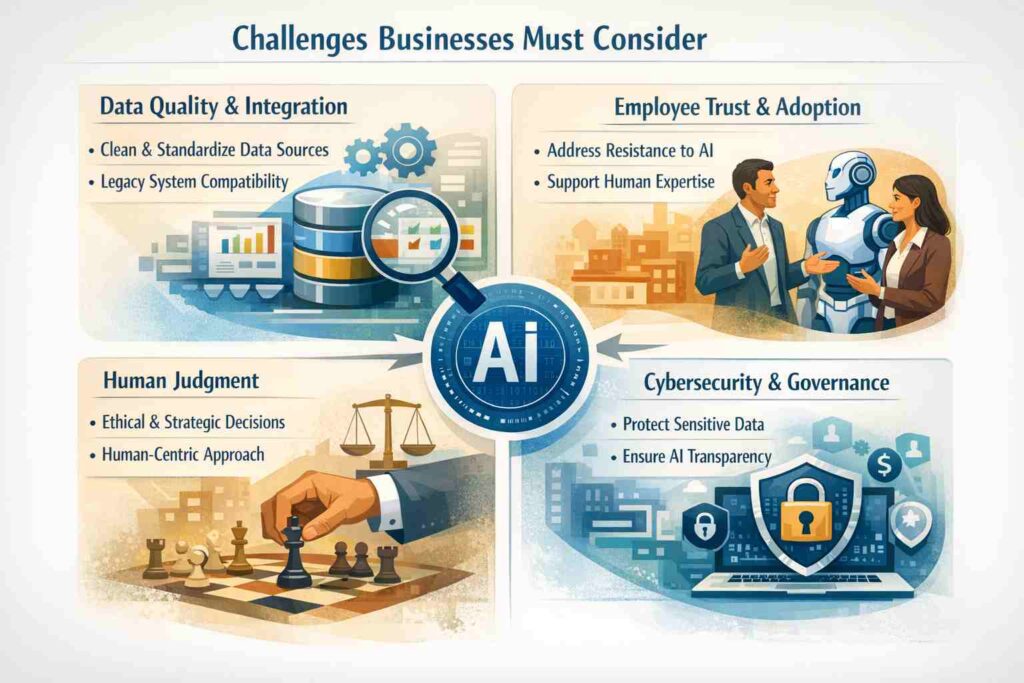
Although Decision Intelligence offers major benefits, successful adoption requires preparation. Poor data quality can lead to weak recommendations, so businesses must clean and standardize their data sources. Integration with legacy systems may also require technical planning.
Employee trust is another challenge. Some teams may resist AI-driven recommendations. Companies should present Decision Intelligence as a support tool rather than a replacement for human expertise. Human judgment remains important for ethical, strategic, and relationship-based decisions.
Cybersecurity and governance are also essential. ERP systems contain sensitive financial, customer, and employee information. Strong security controls and transparent AI policies are necessary in 2026.
Best Practices for Implementing Decision Intelligence in ERP
Organizations should begin with clear business goals. Instead of adopting Decision Intelligence for trend purposes, companies should focus on measurable outcomes such as reducing inventory costs, improving forecast accuracy, or increasing customer retention.
Data readiness is critical. Businesses need clean, connected, and reliable data across departments. Without strong data foundations, intelligent recommendations lose value.
Training employees is equally important. Staff should understand how Decision Intelligence works, how to interpret recommendations, and when to apply human judgment.
Companies should also start small. Launching pilot projects in finance, inventory, or sales forecasting allows businesses to prove ROI before expanding enterprise-wide.
The Future of Decision Intelligence in ERP
The future of ERP is becoming more autonomous. In coming years, Decision Intelligence will move from recommending actions to automatically executing approved decisions. ERP systems may reorder inventory, adjust pricing, reschedule production, or detect fraud in real time without manual intervention.
Conversational AI will also play a larger role. Leaders may ask ERP systems natural language questions such as “What caused profit decline last quarter?” or “Which suppliers create the highest risk?” and receive immediate strategic answers.
Hyper-personalization is another future trend. ERP dashboards will adapt to each user role, showing insights specific to executives, finance managers, warehouse teams, or HR leaders.
Why Businesses Should Invest Now
Companies that delay modernization risk slower decisions, higher costs, and weaker competitiveness. Businesses adopting Decision Intelligence in ERP today gain a strong advantage through agility, efficiency, and smarter planning. In a world where speed and precision matter, intelligent decision-making is no longer optional.
Conclusion
Decision Intelligence is redefining ERP systems in 2026 by transforming them from data storage platforms into strategic decision engines. It empowers organizations with predictive insights, automated recommendations, scenario planning, and real-time responses. From finance and HR to supply chain and manufacturing, every department benefits from smarter decisions. As technology continues to evolve, businesses that embrace Decision Intelligence will lead the future with confidence, efficiency, and innovation.

Leave a Reply