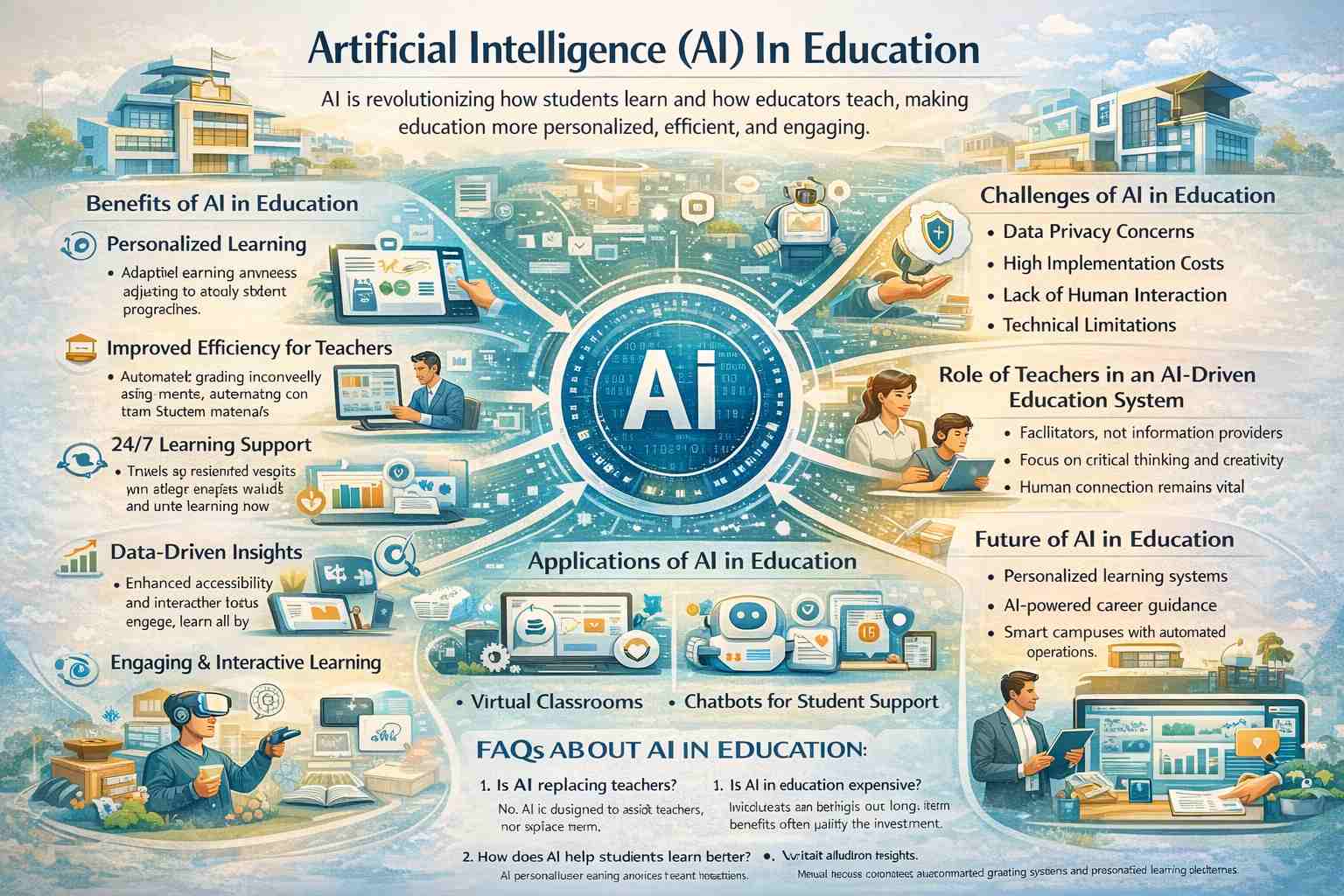
AI in Education: Artificial Intelligence (AI) is reshaping industries across the globe, and education is no exception. From personalized learning experiences to automated administrative tasks, AI is revolutionizing how students learn and how educators teach. This article explores the role of AI in education, its benefits, challenges, and what the future holds.
What is AI in Education?
AI in education refers to the use of machine learning algorithms, natural language processing, and data analytics to enhance teaching and learning processes. These technologies can simulate human intelligence to perform tasks such as grading, tutoring, and content delivery.
AI-powered systems analyze student data to adapt educational content, making learning more efficient and engaging. This creates a smarter, more responsive educational environment.
Benefits of AI in Education
1. Personalized Learning Experience
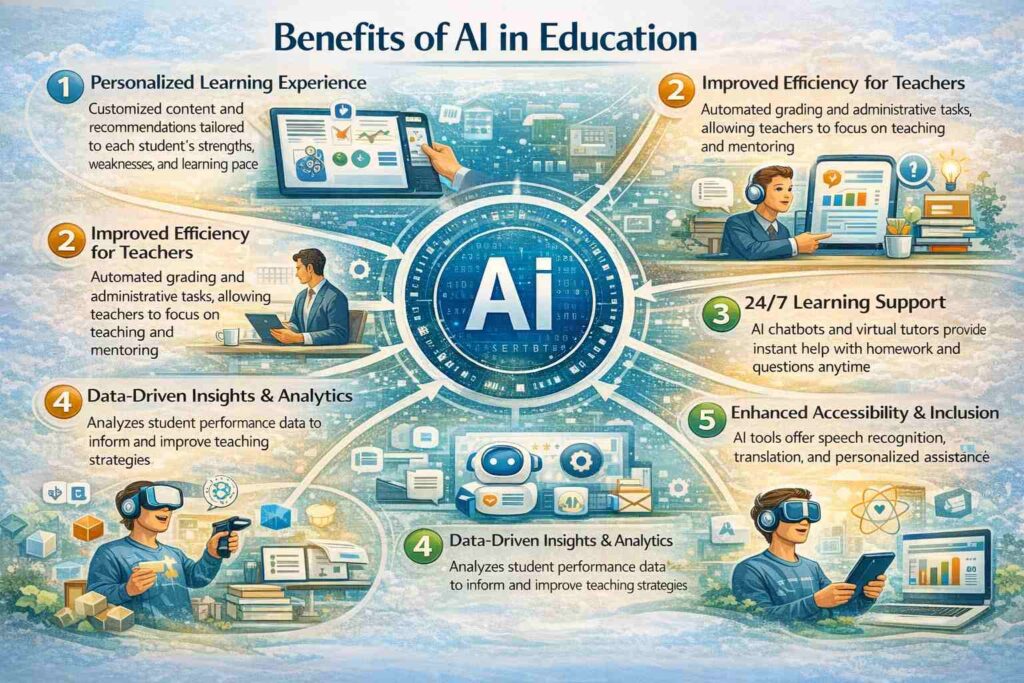
One of the biggest advantages of AI in Education is its ability to provide personalized learning experiences for students. AI-powered systems analyze individual learning patterns, strengths, and weaknesses to deliver customized content and recommendations. This means students can learn at their own pace, revisit difficult topics, and skip concepts they already understand. Personalized learning not only improves academic performance but also increases student engagement by making education more relevant and adaptive to each learner’s needs.
2. Improved Efficiency for Teachers
AI in Education significantly reduces the workload of teachers by automating routine tasks such as grading assignments, tracking attendance, and managing administrative duties. This allows educators to focus more on teaching, mentoring, and interacting with students. AI tools can also assist in lesson planning by suggesting resources and identifying gaps in student understanding. As a result, teachers can become more efficient and productive while enhancing the overall quality of education.
3. 24/7 Learning Support
Another key benefit of AI in Education is the availability of round-the-clock learning support. AI-powered chatbots and virtual tutors can assist students anytime, anywhere, providing instant answers to questions and helping with homework or revision. This is especially useful for students who may need extra help outside of classroom hours. Continuous access to learning resources ensures that students remain engaged and can overcome challenges without waiting for teacher assistance.
4. Data-Driven Insights and Analytics
AI in Education enables institutions to make smarter decisions through data-driven insights. AI systems collect and analyze student performance data to identify trends, predict outcomes, and highlight areas that need improvement. Teachers and administrators can use this information to tailor teaching strategies, provide targeted support, and improve curriculum design. These insights help create a more effective and responsive learning environment for students.
5. Enhanced Accessibility and Inclusion
A major benefit of AI in Education is its ability to make learning more accessible and inclusive. AI tools can support students with disabilities by offering features like speech recognition, text-to-speech, real-time translation, and personalized assistance. This ensures that learners from diverse backgrounds and abilities have equal opportunities to succeed. By breaking down barriers, AI is helping to create a more inclusive and equitable education system.
6. Engaging and Interactive Learning
AI in Education makes learning more engaging through interactive tools such as simulations, gamification, and virtual reality experiences. These technologies help students understand complex concepts in a more visual and practical way. Interactive learning not only improves retention but also makes education more enjoyable. When students are actively involved in the learning process, they are more likely to stay motivated and achieve better results.
Applications of AI in Education
1. Virtual Classrooms
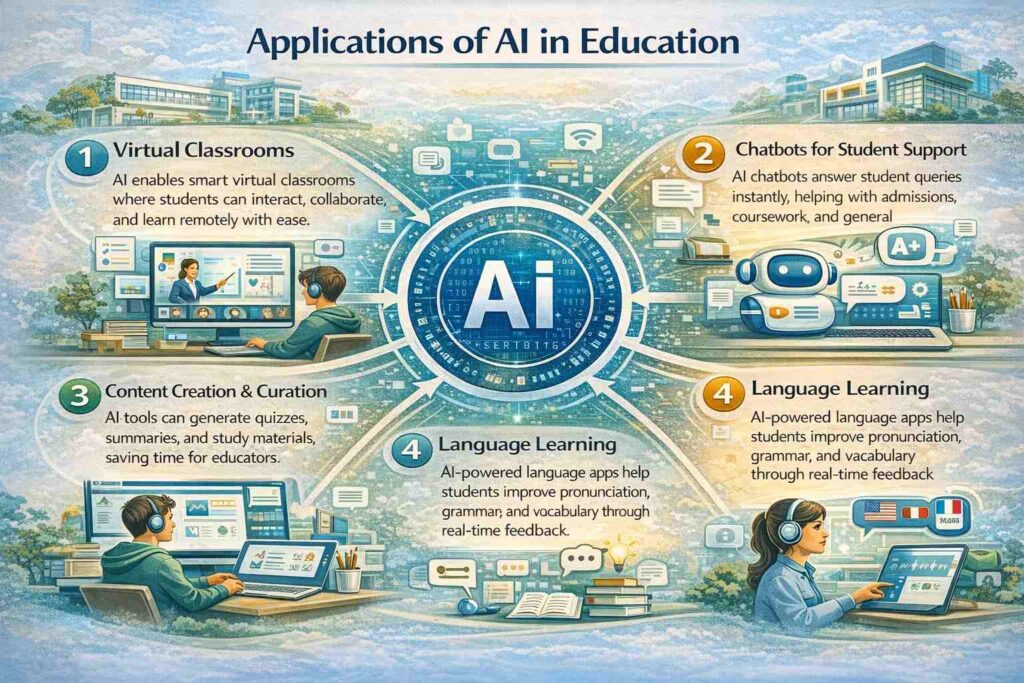
AI enables smart virtual classrooms where students can interact, collaborate, and learn remotely with ease.
2. Chatbots for Student Support
AI chatbots answer student queries instantly, helping with admissions, coursework, and general information.
3. Content Creation and Curation
AI tools can generate quizzes, summaries, and study materials, saving time for educators.
4. Language Learning
AI-powered language apps help students improve pronunciation, grammar, and vocabulary through real-time feedback.
Challenges of AI in Education
1. Data Privacy Concerns
AI systems in education depend heavily on collecting and analyzing large volumes of student data, including personal information, academic records, learning behaviors, and even biometric data in some cases. This raises serious concerns about how securely this data is stored, who has access to it, and how it is being used. Unauthorized access, data breaches, or misuse of sensitive information can put students at risk. Additionally, many institutions may lack strong cybersecurity infrastructure, making them more vulnerable. There is also the ethical question of whether students and parents fully understand and consent to how their data is being utilized, which makes transparency and strict data protection policies essential.
2. High Implementation Costs
Implementing AI in education requires significant financial investment, which can be a major barrier for many schools and institutions, particularly in developing regions. Costs include purchasing advanced software, upgrading hardware, maintaining IT infrastructure, and training staff to effectively use AI tools. Beyond initial setup, there are ongoing expenses such as system updates, technical support, and data management. For institutions with limited budgets, prioritizing AI adoption over other essential resources like teacher salaries or classroom facilities can be challenging, potentially widening the gap between well-funded and underfunded educational systems.
3. Lack of Human Interaction
While AI can enhance learning efficiency and provide personalized experiences, over-reliance on it may reduce meaningful human interaction between students and teachers. Face-to-face communication plays a crucial role in developing social skills, emotional intelligence, and critical thinking. Teachers also provide mentorship, empathy, and motivation—qualities that AI systems cannot fully replicate. If students spend too much time interacting with AI tools instead of real people, it may negatively impact their ability to collaborate, communicate effectively, and build relationships, which are essential skills both inside and outside the classroom.
4. Technical Limitations
Despite rapid advancements, AI systems are not flawless and can sometimes produce inaccurate, incomplete, or biased results. These limitations often stem from the quality of data used to train the AI models—if the data is biased or outdated, the system’s outputs will reflect those issues. In an educational context, this can lead to incorrect assessments, misleading feedback, or unfair treatment of certain groups of students. Additionally, AI systems may struggle to understand complex human emotions, cultural contexts, or unique learning needs, making them less effective in certain situations. Dependence on imperfect technology without proper oversight can therefore create more problems than it solves.
Role of Teachers in an AI-Driven Education System
AI is not meant to replace teachers but to support them. Educators play a critical role in guiding, mentoring, and inspiring students.
- Teachers act as facilitators rather than information providers
- Focus shifts to critical thinking and creativity
- Human connection remains essential
Future of AI in Education
The future of AI in education looks promising, with continuous advancements expected to further transform learning.
- Fully personalized education systems
- AI-powered career guidance
- Smart campuses with automated operations
- Integration of AI with augmented and virtual reality
As technology evolves, education will become more accessible, inclusive, and efficient.
Conclusion
AI is revolutionizing education by making learning more personalized, efficient, and engaging. While there are challenges to address, the potential benefits far outweigh the drawbacks. By embracing AI responsibly, educators and institutions can create a future where learning is smarter and more impactful.

Leave a Reply