Businesses today are under constant pressure to improve efficiency, reduce costs, and make smarter decisions faster than ever before. Traditional enterprise systems helped organizations manage operations, but modern companies now need more than data storage and process automation. This is where AI in ERP is creating a major shift. By combining artificial intelligence with enterprise resource planning systems, businesses can unlock predictive insights, automate repetitive tasks, improve customer experiences, and streamline operations across departments.
In recent years, organizations of all sizes have started adopting AI-powered ERP solutions to stay competitive in a fast-changing market. From finance and human resources to supply chain and customer service, artificial intelligence is changing how ERP systems work. Instead of only recording transactions and generating reports, ERP systems can now learn patterns, forecast trends, and support strategic decision-making.
This article explores everything you need to know about AI in ERP, including benefits, features, use cases, challenges, and future trends.
What is AI in ERP?
AI in ERP refers to the integration of artificial intelligence technologies such as machine learning, natural language processing, predictive analytics, and robotic process automation into enterprise resource planning software.
ERP systems traditionally manage core business functions like:
- Finance and accounting
- Inventory management
- Human resources
- Procurement
- Manufacturing
- Sales and customer management
- Supply chain operations
When AI is added to these systems, ERP software becomes more intelligent and proactive. Instead of waiting for users to enter commands or analyze reports manually, AI can identify patterns, suggest actions, detect anomalies, and automate workflows.
For example, an AI-enabled ERP system can predict inventory shortages before they happen, recommend budget adjustments, or identify suspicious financial transactions in real time.
Why AI in ERP is Important for Businesses
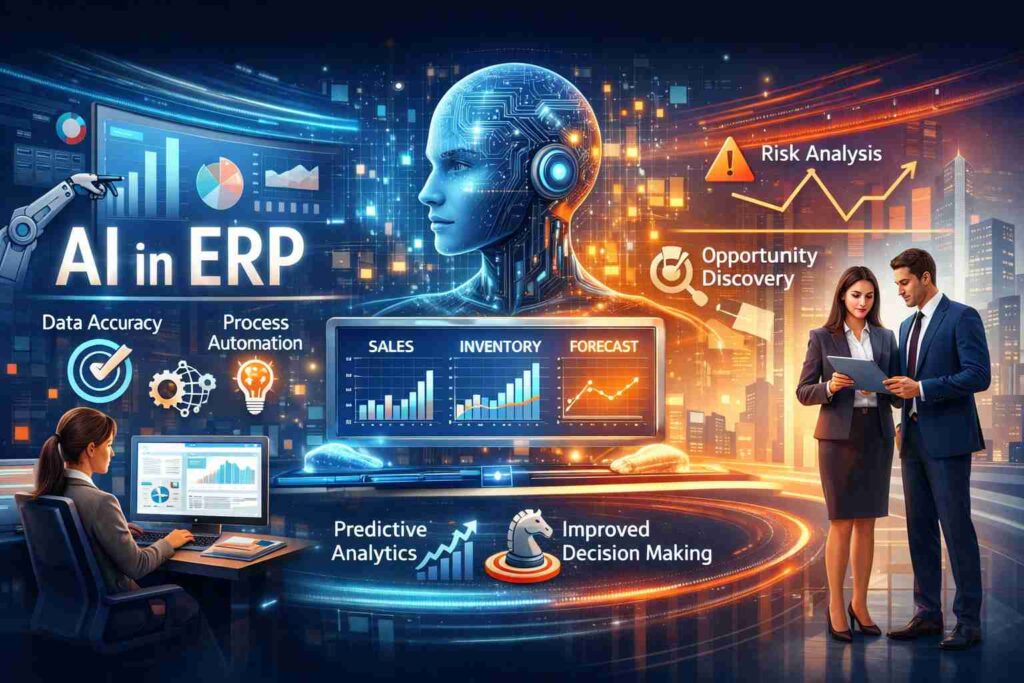
The growing importance of AI in ERP comes from the need for speed, accuracy, and smarter decision-making. Companies handle large amounts of data daily, and manual analysis is often too slow or inaccurate.
AI helps businesses by transforming raw data into useful insights. It reduces human errors, speeds up operations, and enables leaders to make data-driven decisions confidently.
Modern organizations need ERP systems that do more than manage records. They need systems that actively help improve performance, forecast risks, and identify opportunities.
Key Benefits of AI in ERP
Improved Decision Making
One of the biggest advantages of AI in ERP is smarter decision-making. AI can analyze historical and real-time data to identify trends and provide recommendations.
For example, sales trends can help predict future demand, allowing businesses to prepare inventory and staffing levels in advance.
Process Automation
AI can automate repetitive tasks such as invoice processing, payroll calculations, report generation, and data entry. This saves time and allows employees to focus on strategic work.
Automation also improves consistency and reduces delays caused by manual processes.
Better Forecasting
Forecasting is essential for finance, inventory, and production planning. AI algorithms can analyze seasonal demand, customer behavior, and market trends to generate accurate forecasts.
This helps companies avoid overstocking, understocking, and poor budget planning.
Enhanced Customer Experience
AI-powered ERP systems can improve customer satisfaction through faster service, personalized recommendations, and better order management.
Businesses can use AI insights to understand customer preferences and respond more effectively.
Reduced Operational Costs
By automating tasks, reducing waste, improving inventory control, and increasing productivity, AI in ERP helps lower operational costs over time.
Real-Time Insights
Traditional reporting often depends on past data. AI allows ERP systems to provide real-time dashboards, alerts, and recommendations based on current business activity.
Main Features of AI in ERP Systems
Modern AI in ERP solutions include many advanced features designed to improve performance.
Predictive Analytics
Predictive analytics helps businesses forecast demand, revenue, maintenance needs, and workforce requirements.
Intelligent Chatbots
AI chatbots can assist employees and customers by answering questions, checking order status, or helping users navigate the ERP system.
Fraud Detection
AI can monitor unusual financial patterns and flag suspicious transactions quickly.
Smart Inventory Management
AI can track stock movement, reorder products automatically, and optimize warehouse operations.
Automated Reporting
Reports that once took hours can now be generated automatically with actionable insights.
Natural Language Processing
Users can ask questions in simple language like, “Show me last quarter sales performance,” and receive immediate responses.
Use Cases of AI in ERP Across Departments
Finance and Accounting
In finance, AI in ERP helps automate accounts payable, detect fraud, reconcile transactions, and improve budgeting accuracy.
Finance teams can also use AI for cash flow forecasting and compliance monitoring.
Human Resources
HR departments use AI-powered ERP systems for recruitment screening, employee performance analysis, attendance tracking, and workforce planning.
AI can also improve employee self-service through virtual assistants.
Supply Chain Management
Supply chains benefit greatly from AI. ERP systems can predict delays, optimize routes, monitor suppliers, and forecast inventory needs.
This leads to faster deliveries and lower logistics costs.
Manufacturing
Manufacturers use AI In ERP for predictive maintenance, production planning, quality control, and machine performance monitoring.
AI helps reduce downtime and improve production efficiency.
Sales and Customer Service
Sales teams use AI insights for lead scoring, customer segmentation, demand forecasting, and personalized communication.
Customer service teams can respond faster using AI-powered ticket routing and chat support.
Challenges of Implementing AI in ERP
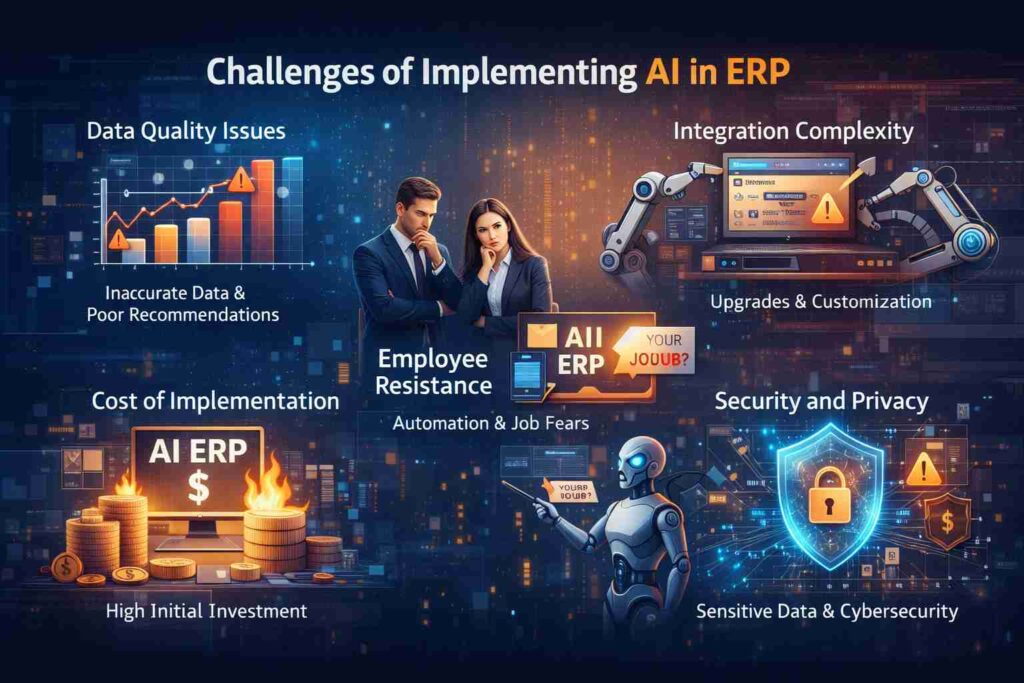
Although the benefits are significant, businesses may face challenges when adopting AI in ERP.
Data Quality Issues
AI depends on accurate data. Poor or incomplete data can reduce performance and lead to wrong recommendations.
Integration Complexity
Older ERP systems may require upgrades or customization before AI tools can be integrated successfully.
Employee Resistance
Some employees may worry about automation replacing jobs. Proper communication and training are important.
Cost of Implementation
Initial investment in AI-powered ERP solutions may be high, especially for large organizations.
Security and Privacy
Since ERP systems store sensitive business data, cybersecurity and privacy controls are essential.
Best Practices for Successful AI in ERP Adoption
To maximize results, businesses should follow these best practices:
- Start with clear business goals
- Clean and organize data before implementation
- Choose scalable ERP platforms
- Train employees regularly
- Begin with high-impact use cases
- Monitor performance continuously
- Ensure strong cybersecurity policies
A phased approach often works better than trying to automate everything at once.
Future Trends of AI in ERP
The future of AI in ERP looks highly promising. Emerging trends include:
Hyperautomation
More business processes will become fully automated using AI, bots, and workflows.
Conversational ERP
Users will interact with ERP systems through voice commands and natural language conversations.
Self-Learning Systems
ERP platforms will continuously improve recommendations by learning from user behavior and business outcomes.
Advanced Personalization
Dashboards, reports, and workflows will become personalized for each user role.
Stronger Predictive Intelligence
Future ERP systems will offer deeper forecasting for risk management, sales growth, and market opportunities.
How Small Businesses Can Benefit from AI in ERP
Many people think AI is only for large enterprises, but this is no longer true. Cloud-based ERP solutions now make AI in ERP accessible to small and medium businesses.
Small companies can use AI to:
- Automate bookkeeping
- Improve inventory control
- Manage customer relationships
- Forecast demand
- Reduce manual workload
- Scale operations efficiently
Affordable subscription models have made adoption easier than ever.
Choosing the Right AI ERP Solution
When selecting an ERP platform with AI capabilities, consider:
- Industry-specific features
- Ease of integration
- Scalability
- User-friendly interface
- Security standards
- Vendor support
- Reporting and analytics tools
- Automation capabilities
Choosing the right system depends on company size, goals, and budget.
Conclusion
AI in ERP is redefining how businesses operate in the digital era. It transforms traditional ERP systems into intelligent platforms that can automate processes, forecast trends, reduce costs, and support faster decision-making.
Whether in finance, HR, supply chain, manufacturing, or customer service, AI-driven ERP solutions deliver measurable value across the organization. While implementation may require planning and investment, the long-term benefits make it a strategic move for businesses that want to remain competitive.
As technology continues to evolve, companies that adopt AI in ERP early will be better positioned for growth, efficiency, and innovation in the years ahead.

Leave a Reply